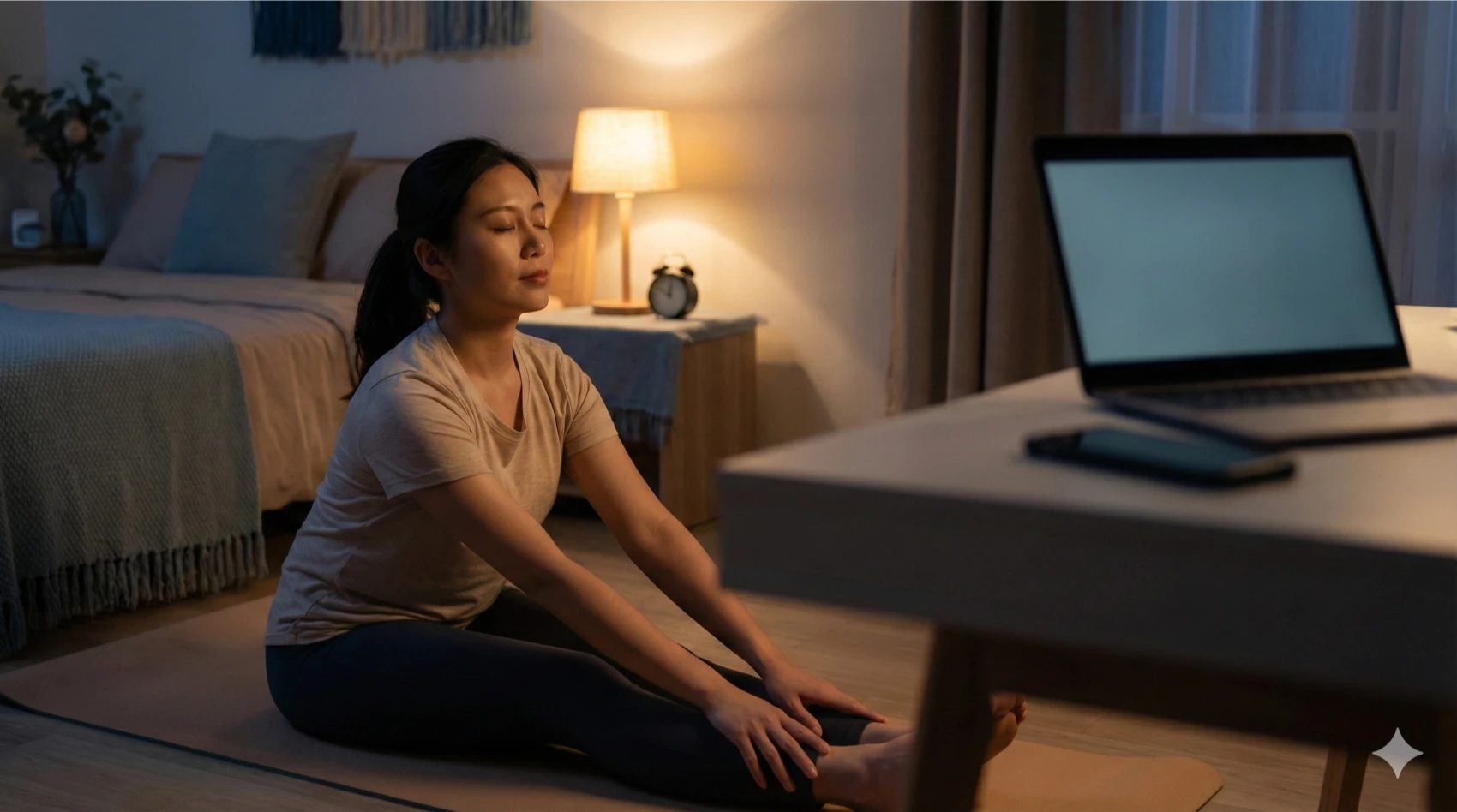

Every deadline got hit today. Eighty-seven emails got answered. Three virtual meetings got sat through. Now it is eleven at night, and the brain simply will not shut off. This is not insomnia in the traditional sense — there is no sleep disorder here, only a modern-life problem: a chronic stress and lifestyle pattern that makes sleep biologically difficult to reach. Research from Johns Hopkins Medicine found that yoga reduces perceived stress by fifty-eight percent and improves stress-related insomnia by sixty-five percent within eight weeks of consistent practice. This is the complete explanation of how work stress creates sleep-blocking biochemistry, why a screen sabotages the body's circadian rhythm, and exactly how a yoga intervention targets each disruption in turn.
01A Modern-Life Problem, Not a Sleep Disorder
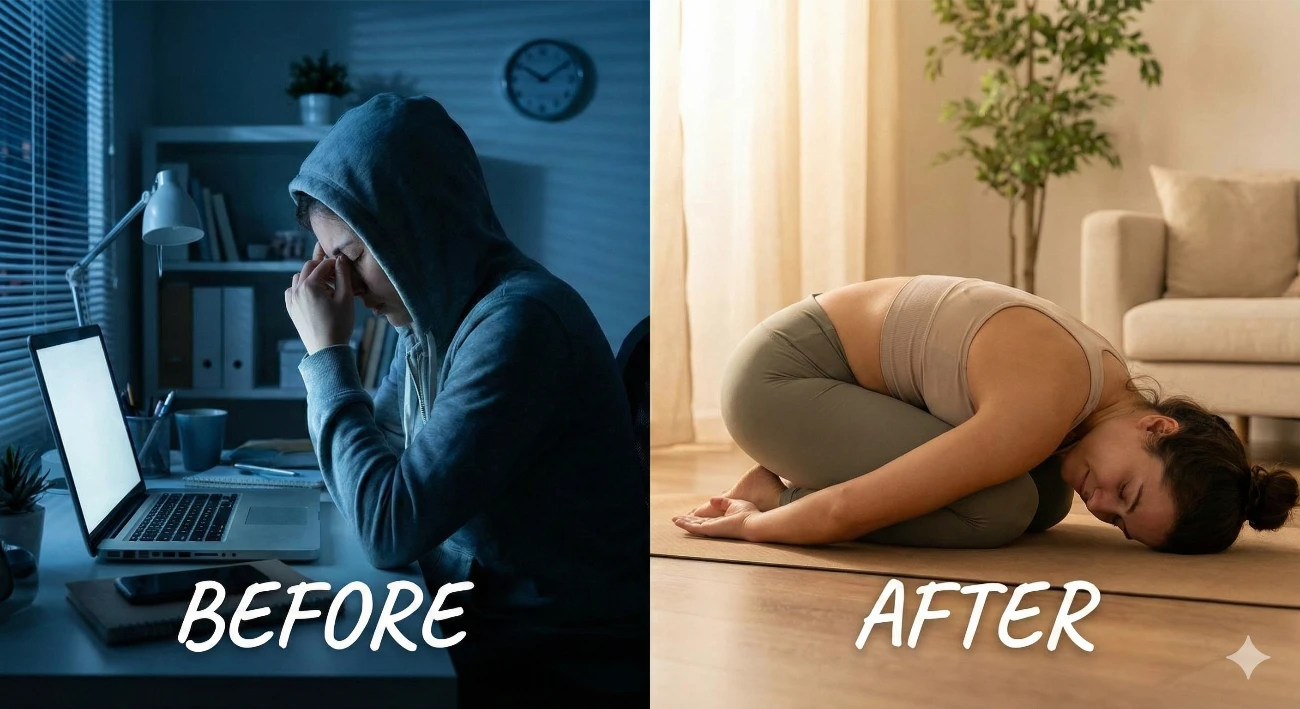
The body genuinely cannot tell the difference between running from a predator and responding to a difficult work email — both trigger the exact same stress response, and that response is what blocks sleep most nights, not any actual sleep pathology. The sections ahead trace that mechanism precisely: how work stress reaches the body biochemically, how a screen disrupts melatonin specifically, why the nervous system ends up overstimulated by evening, and the long-term habit that actually corrects the pattern rather than just papering over one bad night.
02Work Stress and Mental Overload
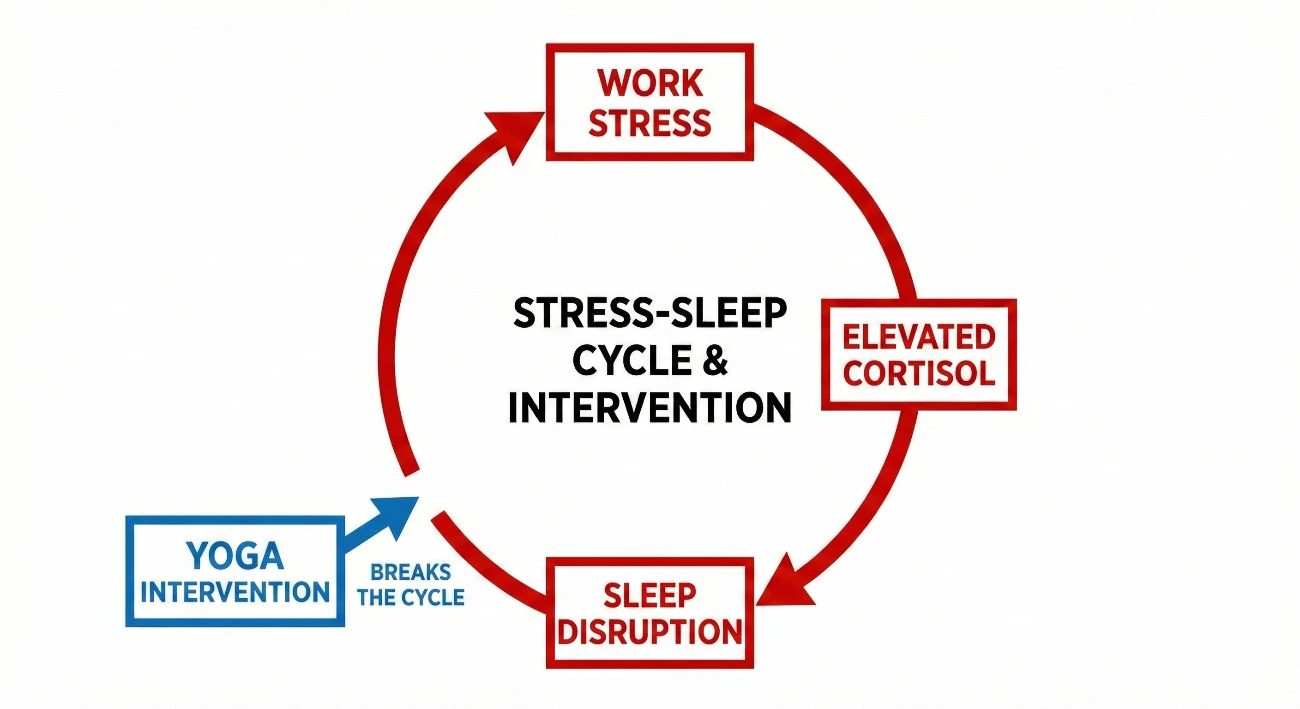
Work stress does not end the moment a laptop closes. It lives on in the body as a biochemical activation that directly prevents sleep from arriving on schedule.
Cortisol, the body's primary stress hormone, should peak naturally in the morning and drop steadily by evening. Chronic work stress keeps it elevated all day and well into the night instead, and a high evening cortisol level is physiologically incompatible with sleep — even once work genuinely stops, cortisol takes three to six hours to actually decrease. This single mechanism explains most of what gets called stress-induced insomnia: elevated cortisol persisting past bedtime, suppressed melatonin production, a sympathetic nervous system still switched on, a body temperature that will not drop the way sleep onset requires, and a deep sleep stage blocked even when sleep does eventually arrive.
Mental overload compounds the biochemistry with its own separate loop. The prefrontal cortex, the thinking brain, stays online exactly when it should be powering down for the night, and research from the Sleep Research Society found that work-related rumination delays sleep onset by an average of forty-three minutes on its own. Multiple daily stressors create an overlapping wave of adrenaline through the day, and by evening the body is physiologically wired despite feeling mentally exhausted — the classic “tired but wired” state that defines stress-induced insomnia specifically.
03Screen Exposure and Sleep Disruption
A phone, laptop and tablet are genuine sleep saboteurs, disrupting sleep through several separate biological pathway at once.
Blue light, in the 450 to 480 nanometre range specifically, directly suppresses melatonin production — the brain reads it as daylight and signals “stay awake” in response, regardless of the actual hour. A single hour of evening screen exposure suppresses melatonin by roughly fifty percent for up to three hours after the screen goes dark, a genuinely significant effect for something as ordinary as checking a phone before bed.
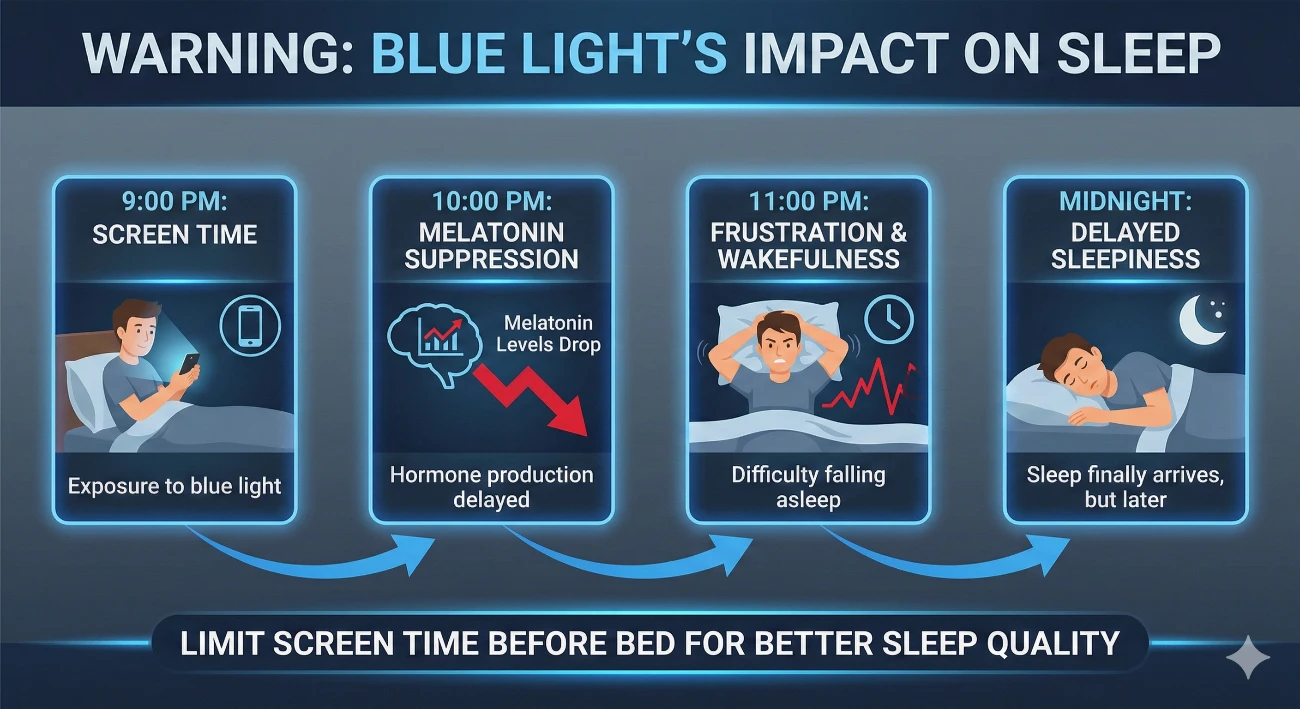
Meaningful improvement calls for ninety to a hundred and twenty minutes screen-free before sleep, and a few practical boundaries make that genuinely achievable: a device curfew set ninety minutes before bedtime, the phone removed from the bedroom entirely rather than merely silenced, a blue-light filter if evening use is truly unavoidable, and an evening scroll replaced with a calming evening and bedtime yoga practice built specifically for winding down instead.
04Nervous System Overstimulation
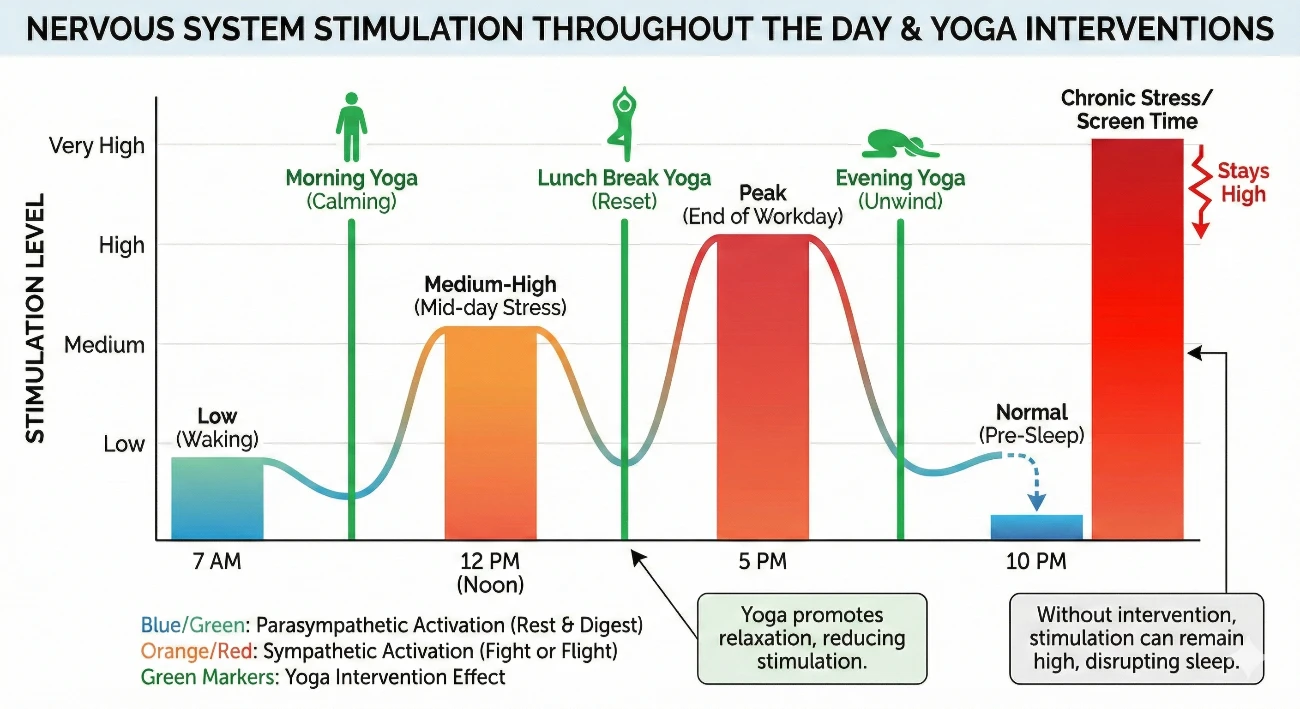
Modern life bombards the nervous system with a constant input, and by evening the accumulated stimulation reaches a point where sleep becomes neurologically difficult rather than simply undesired. A hundred or more notification across devices, eight to twelve hours of artificial lighting, and a constant ambient noise and visual overstimulation all stack up across an ordinary day without anyone consciously tallying the total.
Yoga counteracts this systematically through sensory reduction and deliberate slowness — closing the eyes eliminates visual input outright, while a slow movement signals “no urgency” to a brain that has been running at a different pace all day. A yin yoga approach specifically addresses overstimulation through a long-held, entirely passive pose, which is precisely the opposite input the nervous system has been receiving since morning.
05Yoga's Role in Stress Reduction
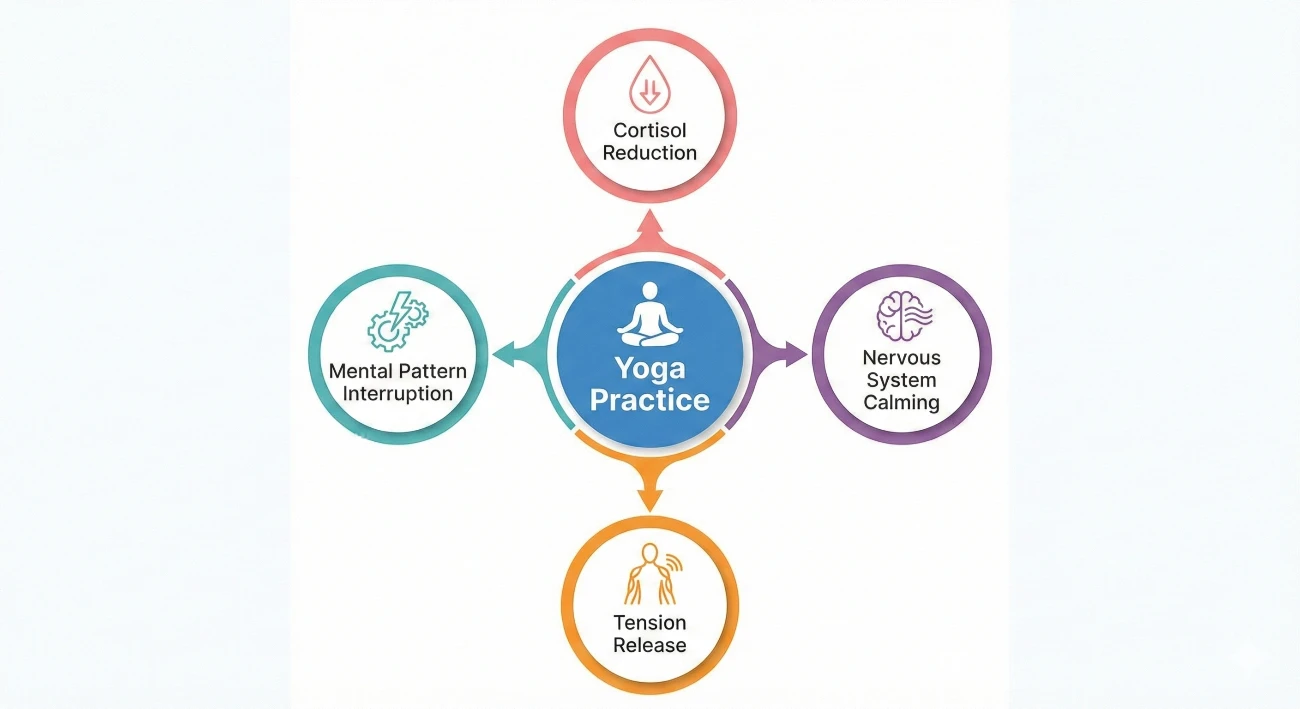
Yoga is not simply relaxation here — it is a systematic reprogramming of the nervous system, addressing stress-induced insomnia through several biological mechanism working simultaneously rather than any single one alone.
A forward fold activates the parasympathetic system directly and reduces cortisol measurably. A hip opener releases the emotional tension so often stored specifically in that part of the body. A twist massages the internal organ and aids cortisol metabolism as a direct physical side effect of the wringing motion. And breathing practice, through dedicated pranayama techniques to calm the mind, activates the vagus nerve directly rather than indirectly. Regular practice does more than reduce the stress present today — it builds a genuine stress resilience over time, and studies show that eight consistent weeks of yoga increases vagal tone by thirty to forty-five percent.
06Correcting the Habit Long-Term
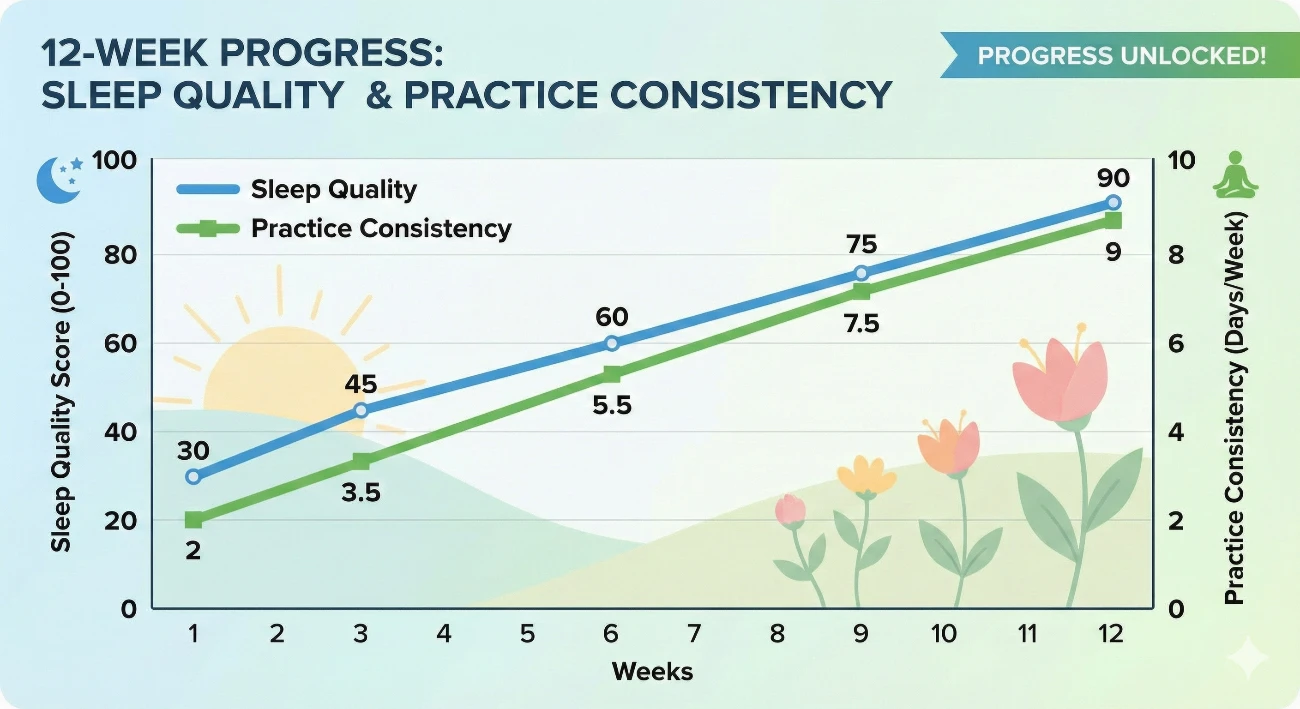
Stress-induced insomnia creates a bad sleep habit that persists even once the original stress has eased, and yoga helps correct that ingrained pattern by building a genuinely sustainable routine around it rather than simply treating one difficult night at a time.
A workable framework starts small and stays honest about it: ten minutes nightly to begin, an amount genuinely achievable on the worst day as well as the best; linked to an existing habit, right after brushing teeth, so motivation is never the load-bearing element; maintained through the weekend too, to rebuild a circadian rhythm rather than resetting it every Monday; and tracked with a simple indicator — time to fall asleep, morning energy level — so the improvement becomes visible rather than merely felt. Most people see a significant shift around week six to eight of consistent practice, and for anyone wanting to extend beyond sleep specifically, a broader yoga for stress relief approach offers the same tools applied more widely through the day.
“The body cannot tell the difference between running from a predator and answering a work email. Both trigger the exact same response that blocks sleep.”
The heart of it
- Elevated evening cortisol, not a sleep disorder, is the actual mechanism behind most stress-induced insomnia.
- A single hour of screen time before bed suppresses melatonin by roughly fifty percent for hours afterward.
- Forward folds, hip openers, twists and breathwork each interrupt the stress-insomnia cycle through a different channel.
- Ten consistent minutes nightly, tracked and linked to an existing habit, outperforms an occasional longer session.
Build a genuinely restful sleep routine, guided by experienced teachers.
Reserve Your Seat