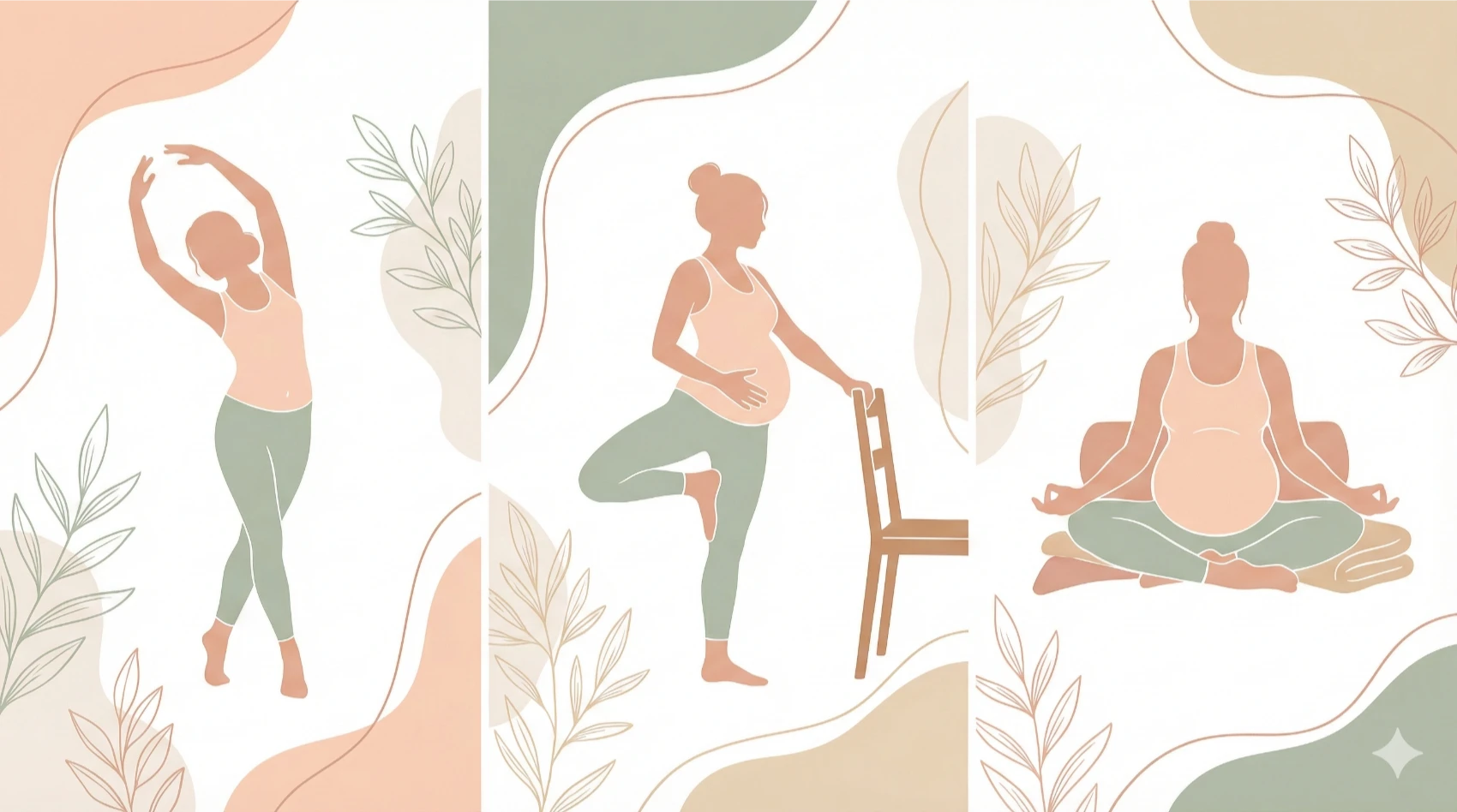

One yoga approach does not work through all of pregnancy, and the reason is simply the body's own dramatic transformation across roughly forty weeks. What feels safe and genuinely beneficial at eight weeks might feel uncomfortable, even risky, by twenty-eight — the practice has to evolve as intentionally as the baby growing alongside it. This is the complete, trimester-by-trimester guide: what changes in each roughly thirteen-week phase, how intensity should shift across all three, the mistakes that show up at every stage regardless, and how to honour the whole journey rather than fight against it.
01Why One Approach Never Works Throughout
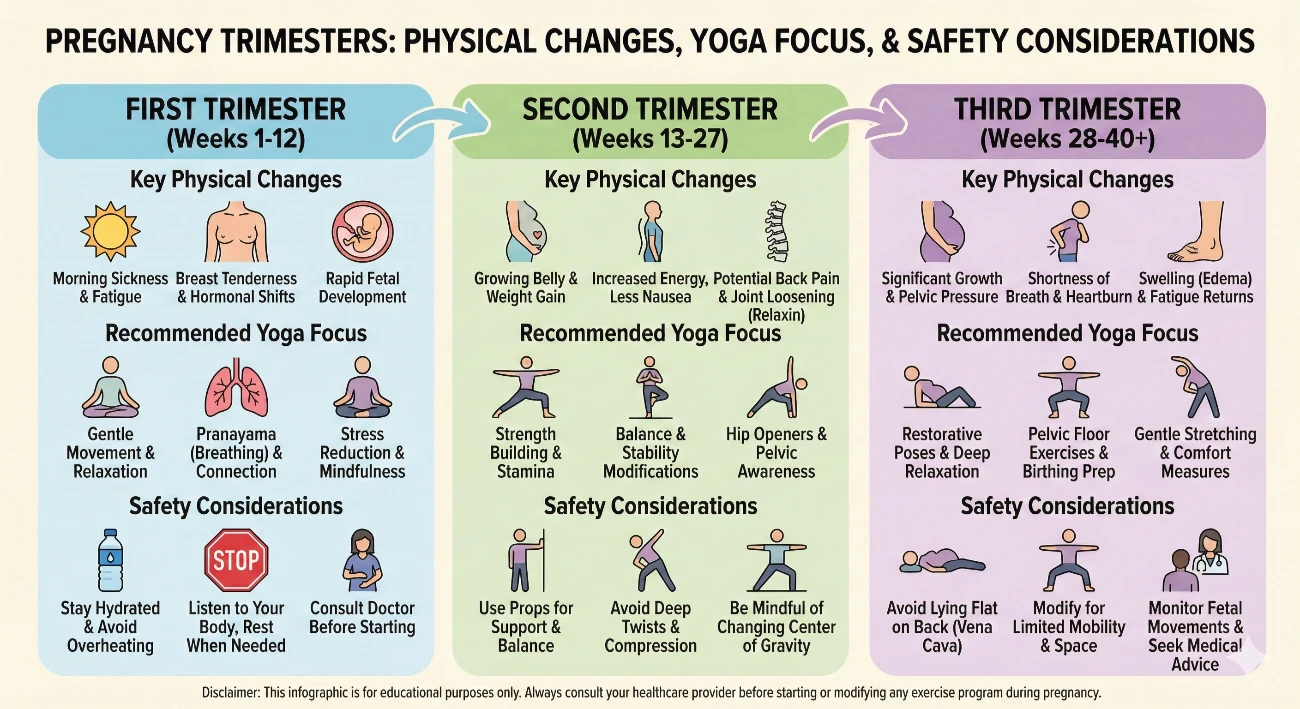
First-trimester fatigue is nothing like third-trimester heaviness. Early pregnancy brings an invisible change — a flood of hormone, embryo implantation, an entire organ system quietly forming beneath the surface. Later pregnancy brings a visible expansion instead, a postural shift, and a real preparation for birth itself. Trimester-based practice is not about restriction for its own sake; it is intelligent adaptation that maximises benefit while genuinely honouring the body's changing need at each stage along the way.
Ancient Ayurvedic text recognised this same staged nature of pregnancy long before modern obstetrics existed to describe it — the Garbha Upanishad describes how the developing child passes through a distinct stage, each one requiring a different kind of maternal support in turn. Research in the International Journal of Yoga found that trimester-appropriate practice reduces pregnancy complication by thirty-five percent compared with a generic prenatal exercise routine applied uniformly — specificity, in this particular case, genuinely matters.
02First Trimester: Stability and Sensitivity (Weeks 1–13)
The first trimester is the body's silent revolution. The belly barely shows, yet internal change happens at genuine speed — progesterone surges to support the developing embryo, and that surge alone can produce exhaustion, mild nausea and real emotional sensitivity almost overnight.
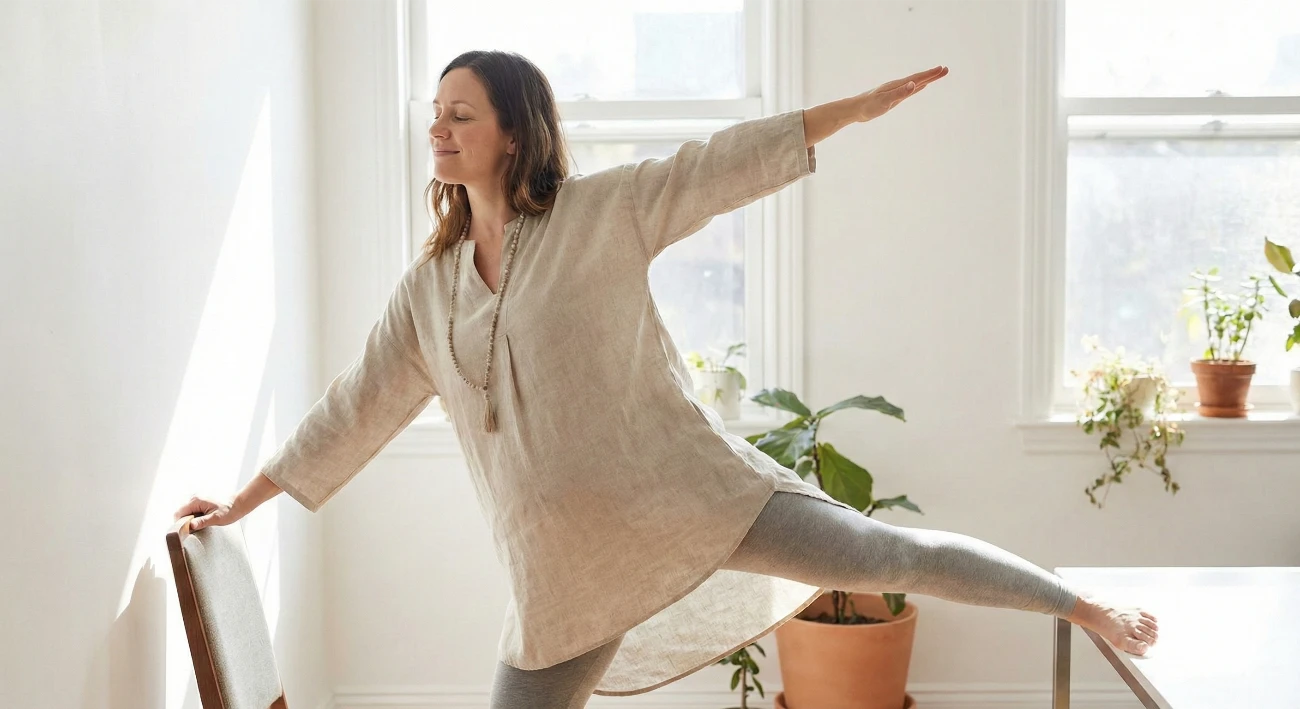
Yoga is absolutely safe this early, provided a handful of crucial modifications start immediately rather than waiting for the belly to show. Practice in this window favours gentle movement over intensity — a power flow set aside entirely, since building an entire human nervous system already demands enormous energy on its own. Grounding and stability matter more than usual, and a standing pose held with wall support helps maintain a sense of centre through genuine hormonal chaos. Breath awareness without retention develops a pattern useful for labour later, while skipping breath-holding altogether, since the baby needs a constant oxygen supply from the very start.
A deep twist and an intense core sequence — Boat Pose, a full plank — are avoided immediately rather than gradually phased out, and temperature control matters considerably in these early weeks specifically, since overheating can affect neural-tube development at this exact stage. Practising in a cool environment and staying well hydrated covers most of the real risk here. A safe first-trimester session leans on a supported Warrior variation, Cat-Cow, and Child’s Pose with the knees held wide, while a deep twist, a full plank, hot yoga and a deep backbend are set aside until well after birth.
03Second Trimester: Strength and Posture (Weeks 14–27)
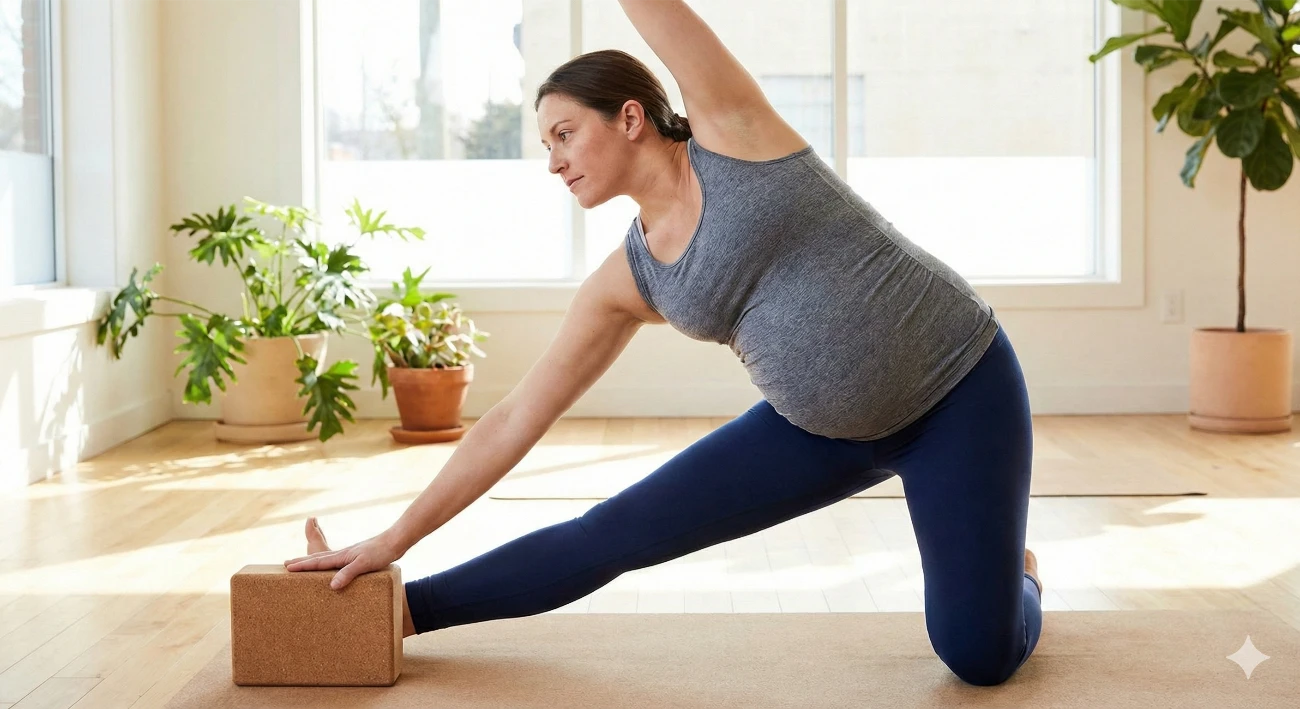
This is often called the golden trimester for good reason — energy genuinely returns, and the belly becomes beautifully, unmistakably obvious. It is the ideal window for establishing a consistent practice rhythm, though the shifted centre of gravity makes an unsupported balance pose genuinely riskier than it was even a few weeks earlier.
Priorities shift here toward strengthening without straining — building leg and back strength specifically to support the growing weight ahead — alongside a lateral movement that gives the baby room to grow and the lungs space to breathe more fully. Pelvic-floor awareness becomes genuinely useful too, learning to release and relax the muscle in preparation for birth rather than only strengthening it.
A back-lying position should phase out between sixteen and twenty weeks specifically, to avoid vena cava compression, switching instead to a side-lying variation — the left side in particular, to optimise blood flow to the placenta. Research in the Maternal and Child Health Journal found that regular yoga through the second trimester can lead to forty percent less lower back pain than going without it. A block and a bolster become genuinely essential partners from this point forward, not optional extras.
04Third Trimester: Comfort and Relaxation (Weeks 28–40)

The final stretch brings the maximum physical challenge of the whole pregnancy, and the practice now shifts its focus firmly toward comfort, mobility and a genuine mental preparation for birth rather than anything resembling fitness.
Shortness of breath becomes common as the baby presses against the diaphragm, and every pose from this point needs to allow for a full, comfortable breath throughout. A pelvic rocking movement and a supported squat help relieve back pressure directly while encouraging an optimal position for the baby as birth approaches. A beneficial third-trimester session favours a supported Child’s Pose, a side-lying pose, a pelvic rock and a supported squat, while avoiding any belly compression, lying flat on the back, or a quick transition between poses.
As midwife Ina May Gaskin notes, a woman who maintains yoga through late pregnancy often feels more confident and empowered during labour as a direct result. A session shortened to fifteen to twenty minutes at this stage is entirely appropriate, not a sign of falling short of some earlier standard.
05How Intensity Should Shift Across Pregnancy
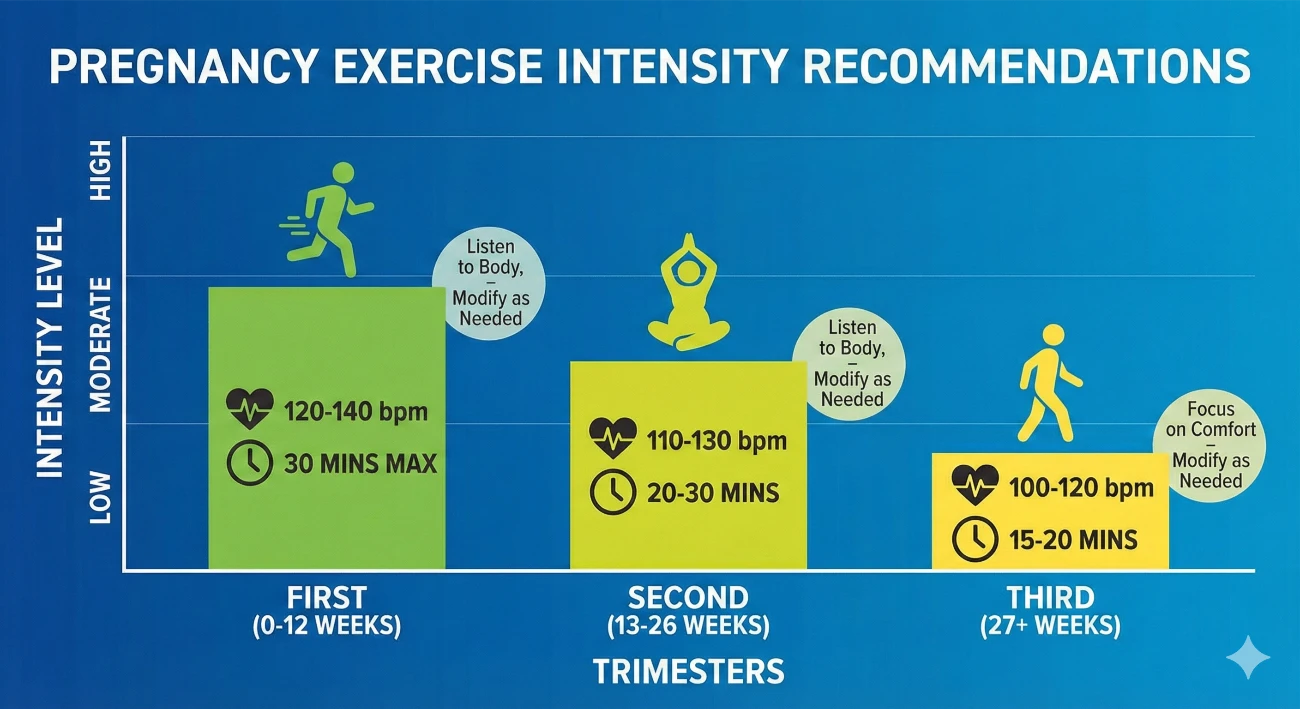
Intensity decreasing as pregnancy progresses is wisdom, not weakness. The second trimester allows for the highest intensity of the three, though the talk test remains the limit throughout every stage — if a conversation cannot be maintained comfortably, the effort has become too high for the moment.
A heart rate between roughly sixty and seventy percent of maximum, somewhere around one hundred twenty to one hundred forty beats per minute, offers a reasonable general target, though perceived exertion remains the more important guide day to day — the body’s own feedback overrides any general rule whenever the two genuinely disagree.
06Common Mistakes Across Every Trimester
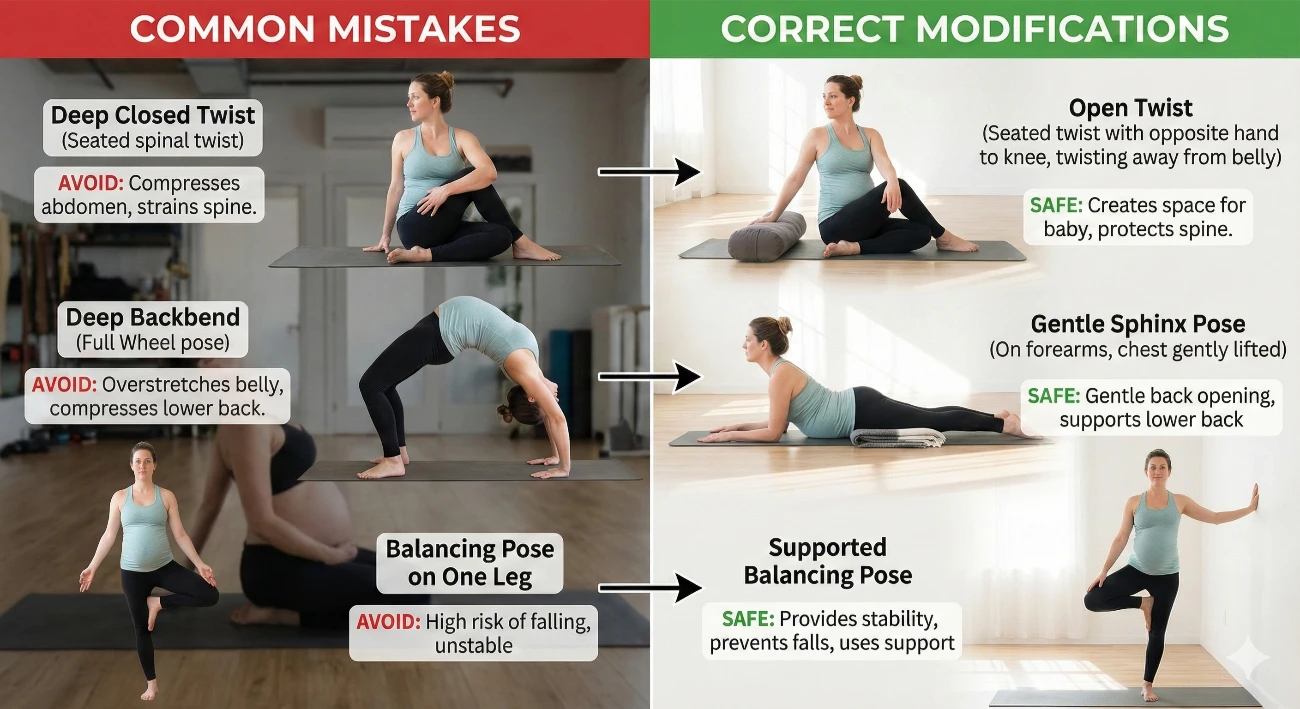
The single biggest mistake is comparing a pregnant practice against pre-pregnancy capability, a comparison that sets an unreasonable and genuinely unsafe standard from the very first trimester onward. Beyond that: holding a pose too long, static holds stretched past five or six breaths; overstretching, since relaxin makes a joint feel flexible while pushing too deep still creates real instability underneath that feeling; ignoring a warning signal, pushing through a pain, dizziness or unusual cramping rather than stopping; and inadequate hydration, which affects amniotic fluid level and body temperature regulation together.
07Honouring the Trimester Journey
The pregnancy yoga journey unfolds trimester by trimester, an intelligent evolution rather than a fixed routine held constant from the first week to the last. From honouring an invisible change in the first trimester, to building strength in the second, to finding comfort in the third, each stage asks something genuinely different of the practice.
Trusting the body's own wisdom, respecting its signal, and adapting continuously across all three stages builds a foundation of breath, focus and strength that carries directly through labour and into motherhood beyond it.
“What feels safe and beneficial at eight weeks might feel risky by twenty-eight. The practice evolves as intentionally as the baby growing alongside it.”
The heart of it
- Each trimester asks something genuinely different of the practice — gentleness first, strength-building second, comfort third.
- A back-lying position phases out between sixteen and twenty weeks regardless of how the pregnancy otherwise feels.
- The talk test remains the one consistent intensity guide across all three trimesters.
- Comparing a pregnant practice to a pre-pregnancy one is the single most common, and most unsafe, mistake made.
Practise a pregnancy yoga routine that grows with every trimester, guided by experienced teachers.
Reserve Your Seat