
Growing a human being transforms the body in ways nothing quite prepares a person for. Hormones shift from the moment of conception — relaxin floods the system, loosening ligament and joint to prepare the pelvis for birth, while progesterone rises sharply enough to explain the exhaustion of the early months entirely on its own. This is the complete guide to practising yoga safely through every stage of that transformation: what is actually happening in the body, how prenatal yoga differs from an ordinary class, the real benefit for mother and baby alike, and exactly when to pause the practice altogether.
01What Actually Happens to the Body
None of this happens uniformly. The centre of gravity shifts forward as the belly grows, and the lower spine curves more prominently in response, creating a strain that simply was not there before. Blood volume increases by nearly fifty percent through pregnancy, and the heart works correspondingly harder to nourish the baby growing on the other end of that circulation. The respiratory system adapts too — the growing uterus pushes the diaphragm upward as the months pass, reducing lung capacity by roughly twenty percent by the later stages.
Research published in the Journal of Obstetrics and Gynecology found a three-hundred percent increase in relaxin levels by the second trimester, which is exactly why joint stability becomes such a genuine priority through the practice from that point onward.
02How Prenatal Yoga Actually Differs
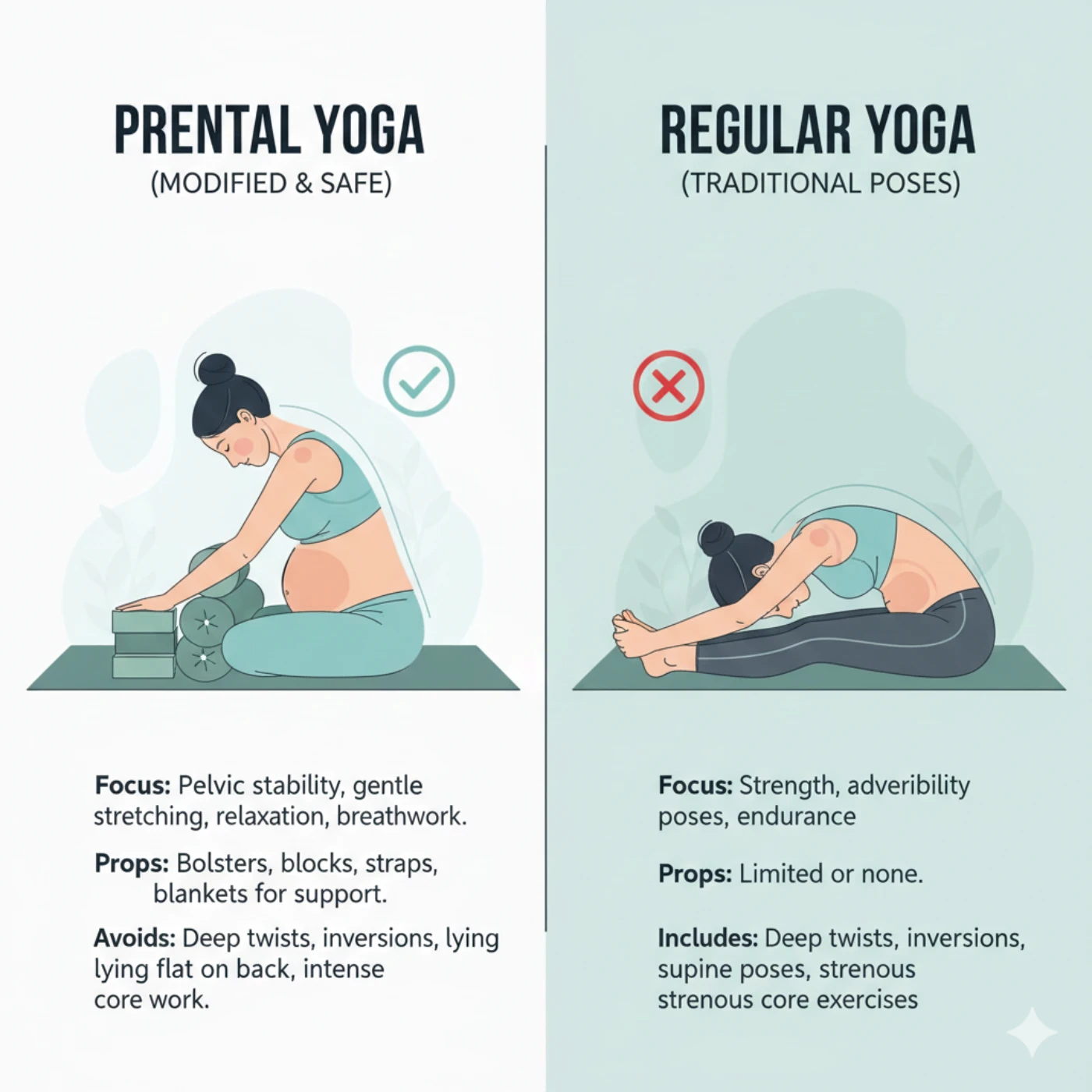
Prenatal yoga is not simply an ordinary class made easier — it is a genuinely redesigned practice built around a different set of priorities entirely. Where a traditional class might push a student toward their edge, pregnancy yoga deliberately pulls back toward centre instead.
Breath becomes the actual foundation, with the pose serving the breathwork rather than the reverse. Balance leans on prop and wall support, since a shifted centre of gravity makes an unsupported balance genuinely riskier than it would otherwise be. Core work is modified specifically to avoid a crunch or a deep twist, protecting against diastasis recti, the separation of the abdominal muscle that pregnancy already predisposes toward. And the practice as a whole prioritises creating space for the baby over building intense muscular strength, which is a meaningfully different goal from most regular class.
Temperature awareness matters more here than almost anywhere else in yoga, since overheating carries a real risk to fetal development. Pregnancy yoga happens in a moderate temperature with frequent water breaks built directly into the session, never in a heated room.
03Benefits for Mother and Baby

The benefit reaches considerably further than flexibility alone. Studies in BMC Pregnancy and Childbirth found that practitioners experience thirty percent less anxiety than non-practitioners, and physical discomfort such as lower back pain responds remarkably well to a targeted, gentle pose chosen specifically for it.
Sleep genuinely improves as the nervous system is trained to downshift more readily, directly countering the insomnia so common in later pregnancy. The pelvic floor strengthens in preparation for birth itself and for a faster postpartum recovery afterward. Gentle movement massages the digestive organs, relieving the constipation that so often accompanies pregnancy hormonally. And improved circulation supports placental health directly, ensuring better oxygen delivery reaches the baby throughout. Joining pregnancy yoga classes also builds a genuine community of expecting mothers around the practice, creating a support network that tends to last well beyond childbirth itself.
04General Safety Principles

Safety sits above every other consideration in this particular practice. Lying flat on the back after sixteen to twenty weeks should be avoided altogether, since the uterus at that stage can compress the vena cava and measurably reduce blood flow as a direct result.
The talk test offers a simple, reliable check: if a conversation cannot be maintained comfortably through the pose, the effort is too high for pregnancy. Heat should be avoided entirely — never practise anywhere the studio temperature exceeds around thirty-nine degrees Celsius. A forward fold should be modified by widening the stance to make real room for the belly, and jumping of any kind should be skipped, since a jarring movement strains the pelvic floor with no real benefit attached to the risk.
05Breath, Awareness and Rest
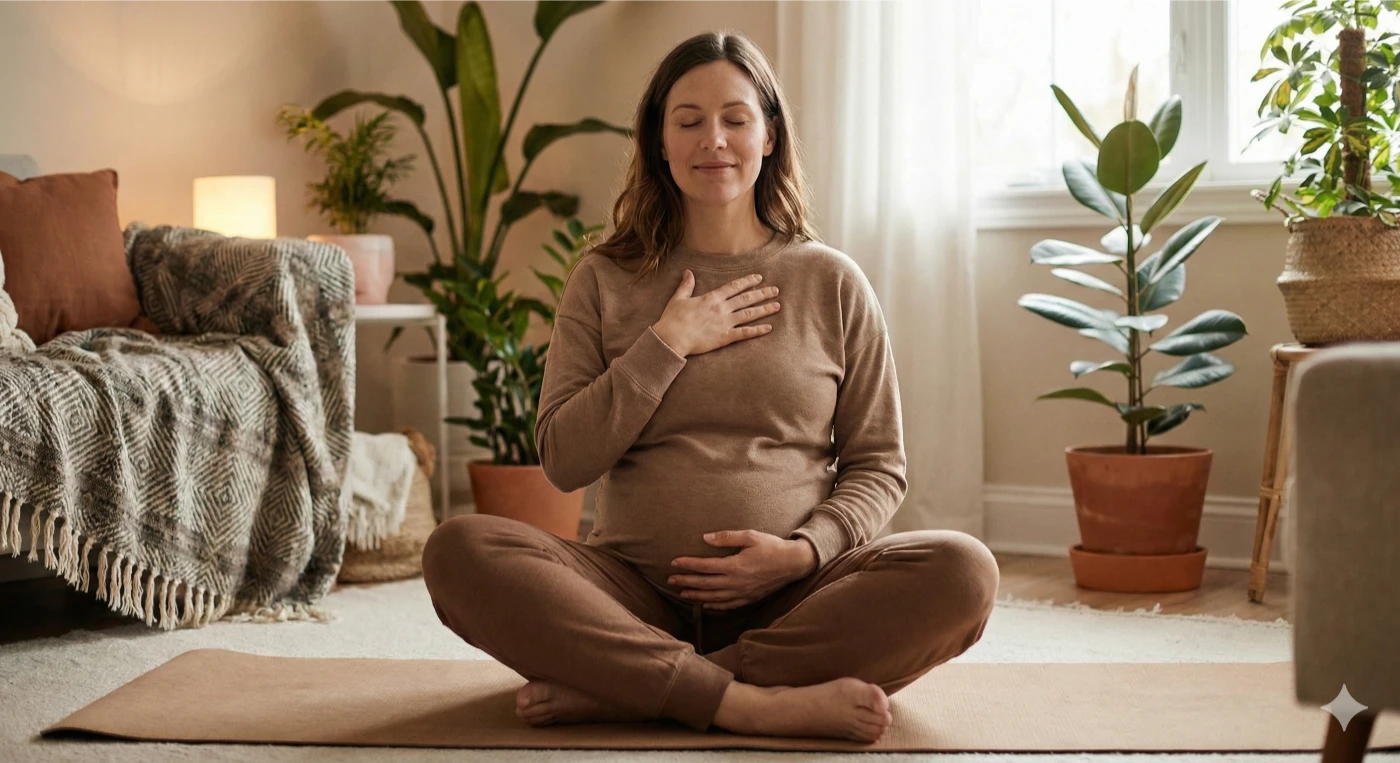
Pranayama shifts in purpose during pregnancy, moving from energising toward calming. Ujjayi breath serves particularly well here, gently preparing the body for the breathing pattern labour itself will eventually call for — though breath retention, holding the breath deliberately, should always be skipped entirely, since it reduces oxygen supply to the baby for no real benefit in return.
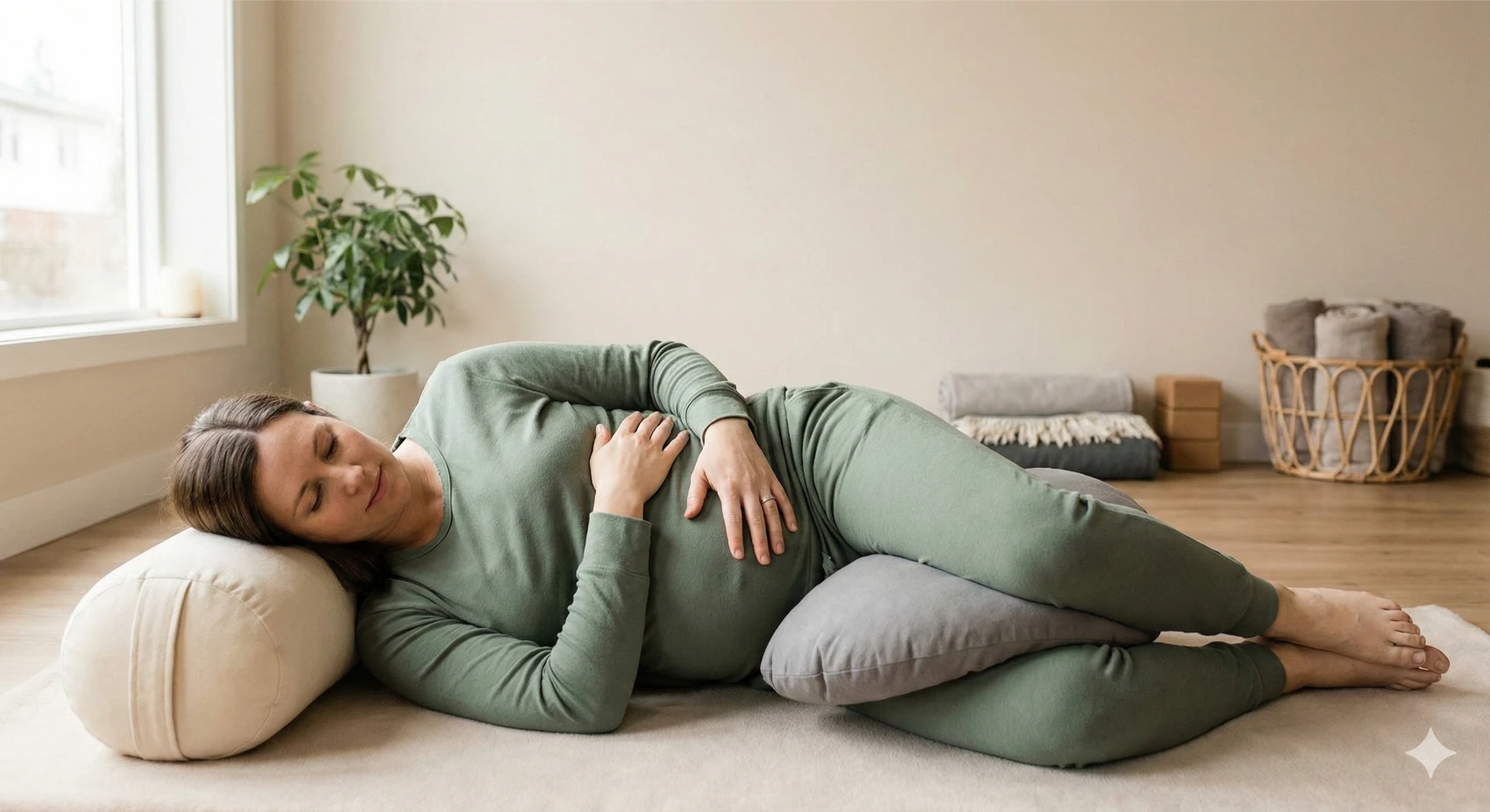
Rest matters just as much as movement. After twenty weeks, side-lying savasana becomes the standard final relaxation position, replacing the flat-back version used earlier in pregnancy. These same cooling, restorative principles extend naturally into a broader modern ayurveda wellness approach for anyone wanting to go further with them.
06Why Qualified Guidance Matters
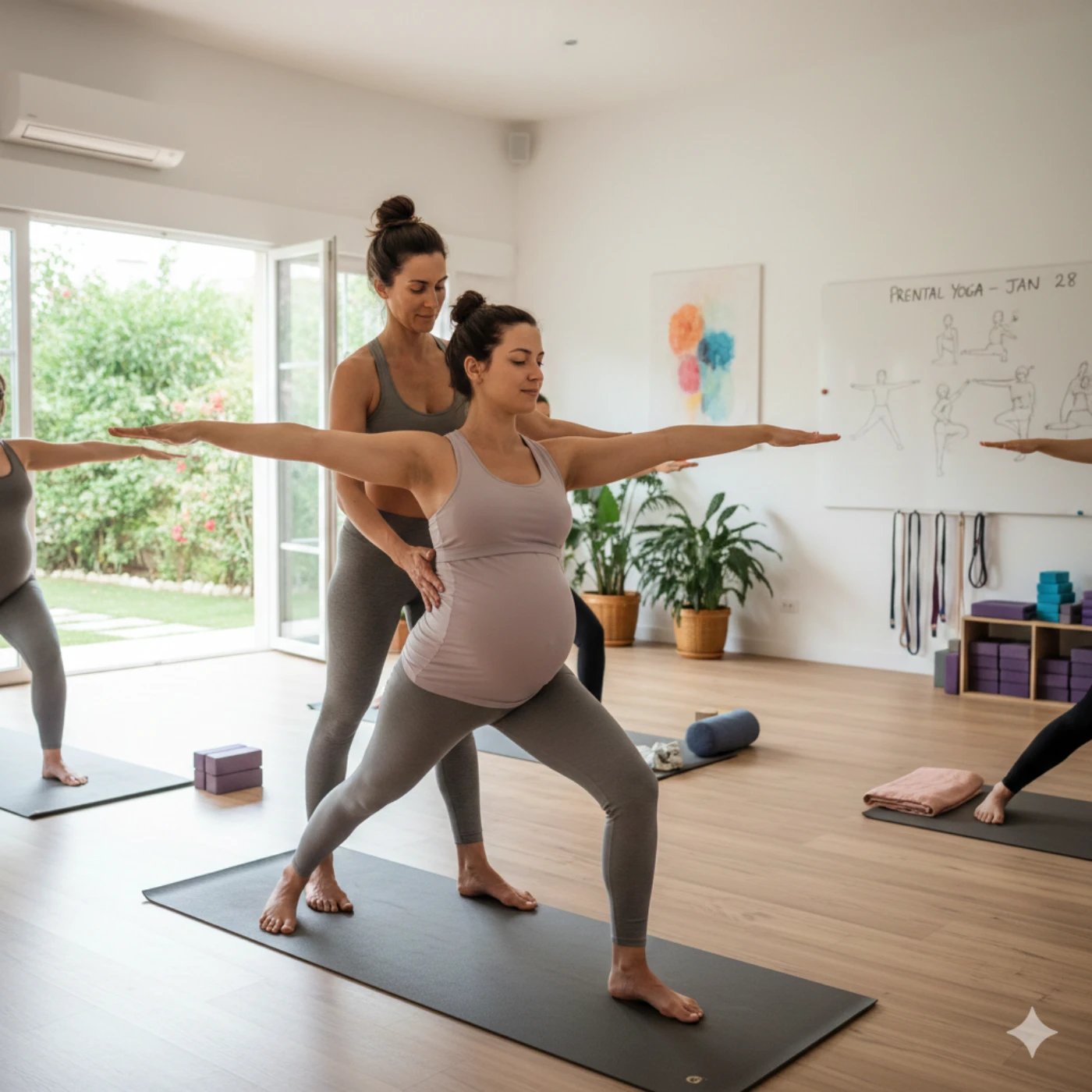
A certified prenatal instructor understands pregnancy physiology in a way a generic trainer often simply does not — recognising, for instance, that a pose entirely safe at fifteen weeks may carry real risk by twenty-five, a distinction that matters enormously and is easy to miss without specific training. Anyone searching for the right instructor should verify 200-hour teacher training yoga alliance credentials alongside a specific prenatal specialisation, since the general certification alone does not guarantee the more specialised knowledge pregnancy actually requires.
07When to Pause or Avoid Practice
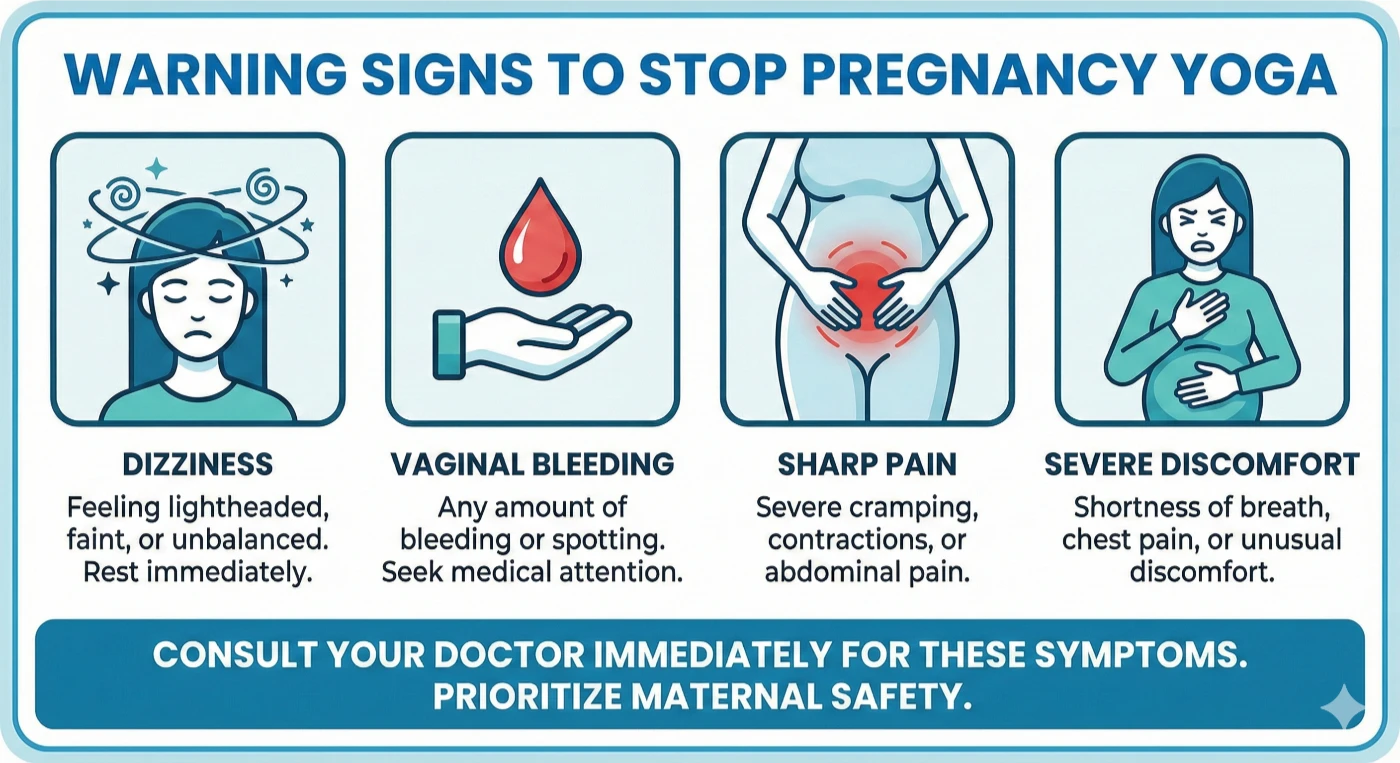
Practice should stop immediately, with a doctor consulted right away, at any sign of vaginal bleeding or persistent cramping, dizziness, a severe headache or a change in vision, decreased fetal movement, or chest pain and heart palpitation. None of these warrant waiting to see if they pass on their own.
The Yoga Sutras teach that asana should be sthira sukham, steady and comfortable — and the moment practice becomes genuinely painful rather than merely challenging, the baby’s wellbeing takes priority over consistency, every single time, without exception.
08Nurturing the Journey
Pregnancy yoga is, at its core, a journey of connection — to the body, to the baby, and to a version of stillness most people rarely make room for otherwise. Honouring these safety principles and modifications creates a genuinely healthy environment for both mother and baby throughout. For anyone ready to begin, a dedicated Prenatal Yoga Programme offers a structured way to start the practice with real, qualified guidance behind it.
“A pose entirely safe at fifteen weeks may carry real risk by twenty-five. Pregnancy yoga is not one practice held constant — it changes shape alongside the body carrying it.”
The heart of it
- Relaxin loosens ligament and joint dramatically by the second trimester, making stability the priority over flexibility.
- Prenatal yoga is a redesigned practice, not merely an easier version of a regular class.
- The talk test and the rule against lying flat on the back after sixteen to twenty weeks are two of the simplest, most reliable safety checks.
- Bleeding, dizziness, decreased fetal movement or chest pain are reasons to stop immediately and call a doctor.
Begin a safe, guided pregnancy yoga practice with experienced prenatal teachers.
Reserve Your Seat