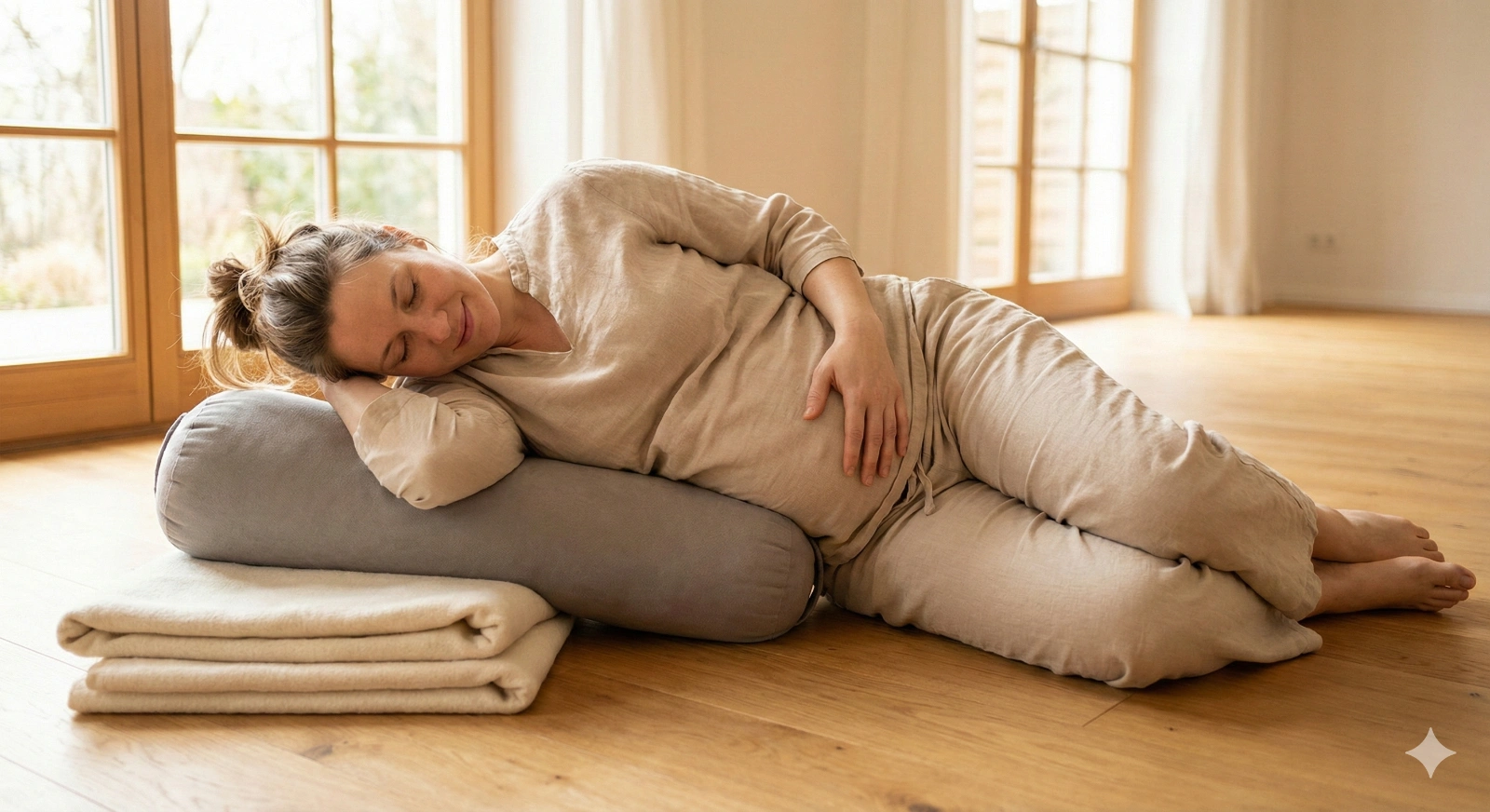

Breath becomes the single most powerful labor tool a pregnant body carries — mastered now, it is there exactly when it is needed later. Conscious breathing does considerably more than relax; research in The Journal of Obstetrics and Gynecology found that pregnant women practising daily breath awareness reported forty-five percent less anxiety and a shorter active labour than those who did not. And the best part is genuinely practical: it requires no mat and no studio, only a body that is always, quite literally, carrying its own tool along with it. This is the complete guide to breath, relaxation, emotional grounding and mental preparation across pregnancy.
01Breath Awareness During Pregnancy

Most people use only around thirty percent of their lung capacity in an ordinary day, and pregnancy breathwork teaches access to considerably closer to the full hundred. The one rule that overrides every technique below: never hold the breath during pregnancy. Every method here should emphasise continuous flow, since retention reduces oxygen delivery to the baby for no offsetting benefit at all.
Ujjayi breath forms the foundation of the whole practice — a gentle, ocean-sounding breath that calms the nervous system while maintaining a steady oxygen flow throughout. Inhale slowly through the nose while slightly constricting the throat, creating a soft, audible sound like a distant wave; exhale through the nose with the same gentle constriction; continue for five to ten minutes daily. None of this is about forcing the breath — it is about noticing the natural rhythm already present and gradually deepening it rather than overriding it.
Three-part breath, dirga pranayama, maximises oxygen for both mother and baby together: one hand on the chest, one on the belly; inhale into the belly first, then the ribcage, then the upper chest; exhale in reverse — chest, ribs, belly. The wave-like pattern this creates becomes genuinely invaluable once labour itself begins. A simple counted breath offers immediate anxiety relief on its own: inhale for a count of four, exhale for a count of six, repeated ten to fifteen times, the longer exhale activating the parasympathetic nervous system directly. And belly breathing with baby connection combines breath with bonding — seated comfortably, hands on the belly, visualising the breath flowing toward the baby while tension releases, becoming an anchor that trains the mind-body connection to stay calm under real intensity later on. A regular morning meditation practice integrates this same breath awareness with gentle movement beautifully for anyone building a consistent routine around it.
Alternate-nostril breathing, nadi shodhana, balances the nervous system with real precision: right thumb closing the right nostril, inhale left; close the left, release the thumb, exhale right; inhale right, switch, exhale left; continue for five to ten rounds. Research by Dr Sat Bir Singh Khalsa at Harvard Medical School found this reduces stress biomarkers by forty percent in pregnant women specifically, gradually retraining the autonomic nervous system to respond more calmly to a stressor generally. Cooling breath, sheetali, addresses the internal heat pregnancy hormones so reliably generate: roll the tongue into a tube, or purse the lips if rolling is not possible, inhale through it, exhale through the nose, five to eight rounds — a genuinely natural cooling with no medication required at all.
02Relaxation for Anxiety and Fear

Pregnancy anxiety is not weakness; it is biology responding honestly to an enormous life change. Studies in Applied Psychophysiology and Biofeedback found that seventy-eight percent of pregnant women experience moderate to high anxiety at some point, and the baby directly experiences that stress too, through the shared blood chemistry connecting the two — when the mother relaxes, the baby relaxes alongside her, cortisol dropping and heart rate stabilising together.
Progressive muscle relaxation teaches the release of tension most people never notice they are holding: lying in a supported side position, starting at the feet, tensing for five seconds and releasing completely, moving systematically upward through the calves, thighs, hips, belly, chest, arms, neck and face, practised fifteen to twenty minutes, three to four times weekly. Yoga Nidra, yogic sleep, an ancient practice described in the Hatha Yoga Pradipika, guides the body into a profound rest while alert awareness is deliberately maintained throughout — a twenty to thirty minute guided recording in a supported side-lying position. Dr Richard Miller of the iRest Institute found that pregnant women practising Yoga Nidra twice weekly experienced a thirty-eight percent reduction in anxiety alongside improved birth outcomes, and twenty minutes of it provides rest roughly equivalent to two to three hours of ordinary sleep.
A restorative pose provides a more passive relaxation on its own — supported Child’s Pose with a bolster for five to ten minutes, or a fully supported side-lying position for ten to fifteen. Judith Hanson Lasater, physical therapist, notes that restorative practice reduces cortisol by twenty-five percent while increasing oxytocin at the same time, a genuinely favourable trade for very little physical effort.
Body-scan meditation cultivates the non-reactive awareness labour itself calls for directly — thirty to sixty seconds per area, noticing sensation without judgement, training exactly the skill needed to observe a contraction without panic. Guided visualisation uses the fact that the nervous system cannot reliably distinguish real experience from a vividly imagined one — eyes closed, the safest place imaginable engaged through every sense, held for ten to fifteen minutes, producing an actual physiological relaxation rather than merely a pleasant thought. A simple loving-kindness meditation, hands on the belly, repeating “may I be healthy and strong, may my baby be healthy and strong, may we both be safe and peaceful,” addresses the fear around motherhood directly rather than around it.
03Emotional Grounding and Calmness
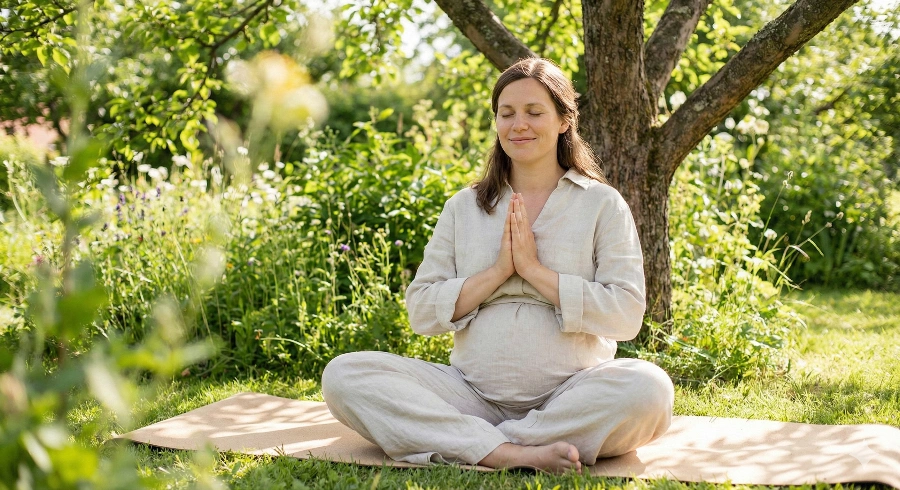
Pregnancy hormone creates a genuine emotional wave, and grounding practice keeps a person from drowning in it rather than pretending the wave isn’t there. Elated one moment, sobbing over a commercial the next — this is not instability; it is an entirely normal hormonal fluctuation working exactly as it should.
Mountain Pose with grounding visualisation: standing feet hip-width apart, visualising roots extending from the feet into the earth, inhaling stability upward and exhaling anxiety downward. Seated grounding breath: sitting tall, inhaling the earth’s steadiness upward, exhaling overwhelm back down into it. Mantra repetition, japa: a resonant phrase chosen deliberately — “I am safe,” “my baby grows perfectly,” “I trust this process” — repeated through the practice rather than saved for a crisis moment. Mindful movement, a slow Cat-Cow or a gentle sway, pulls attention out of anxious thought and back into sensation and presence directly.
Grounding, understood properly, is not suppressing an emotion — it is building a stable foundation from which to actually experience that emotion safely rather than being swept away by it entirely. Expressive journalling processes emotion constructively: a notebook kept near the practice space, five to ten minutes of complete honesty after each session; Dr James Pennebaker’s research shows expressive writing of this kind reduces pregnancy anxiety by thirty-two percent. A daily gratitude practice — three specific pregnancy gratitudes named each day — shifts the emotional baseline gradually over time; the Yoga Sutras of Patanjali (book one, sutra twelve) teach that abhyasa, practice, paired with vairagyam, non-attachment, together create genuine mental stability rather than either one alone.
04Mental Preparation for Childbirth
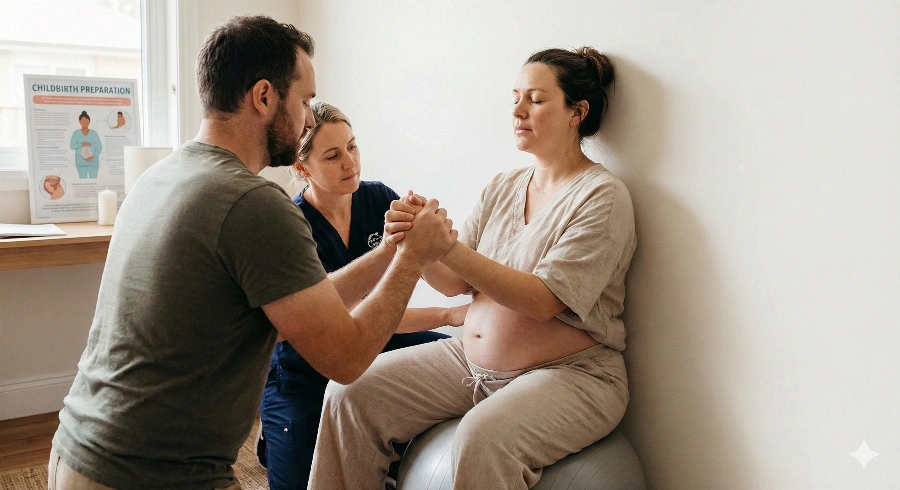
Labour is said to be ninety percent mental — the mind shapes the experience of it more than the body alone ever could. Research in Birth: Issues in Perinatal Care found that genuine mental preparation reduces perceived pain by forty percent and intervention rates by thirty. Every single yoga session that stays calm through real discomfort is, quietly, a rehearsal for exactly that.
Breath-riding practice mimics contraction breathing directly: hold a challenging pose — Chair or Warrior II — and as discomfort builds, maintain a slow, steady breath through it for sixty to ninety seconds, roughly a contraction’s length, rest, then repeat five to eight times. This teaches working with intensity rather than fighting it, which is the entire skill labour actually demands. Mental rehearsal visualisation, in a side-lying position, pictures the ideal labour in real detail — calm, breathing through each contraction, the baby descending and finally being born. A simple mantra for contraction — “open and release,” “riding the wave,” “my body knows how,” “one breath at a time” — practised during a challenging hold carries directly into the room when it matters. Ina May Gaskin, the widely respected midwife, notes that women who practise this kind of mental preparation report feeling considerably more in control during labour itself.
The distinction between pain and suffering matters enormously here: pain is a physical sensation, largely unavoidable; suffering is a mental resistance to it, and that part is genuinely optional. Labour pain serves a real purpose, opening the body for the baby, and resistance to it only increases suffering without reducing the pain itself in any way. A release and surrender practice — supported Child’s Pose or Savasana, consciously releasing tension and noticing resistance to letting go — rehearses exactly this surrender in advance. A short fear-release meditation — naming the biggest birth fear, locating where it sits physically, breathing into that spot with compassion, exhaling the fear out and replacing it with “I am capable, my body is designed for this” — addresses what often cannot be reasoned away directly.
05Building Confidence Through Practice
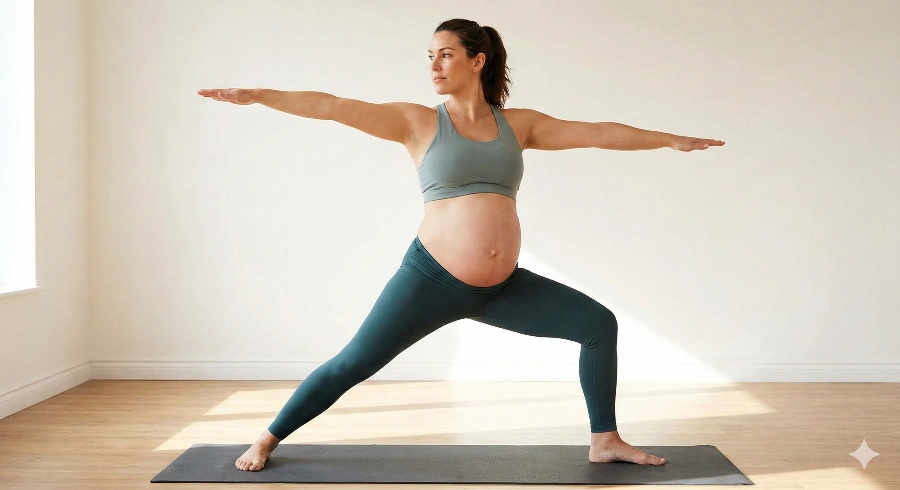
Confidence is not theoretical; it is built through embodied experience, session by session. Every practice that stays present through a real challenge proves capability directly, creating a kind of evidence-based self-trust the mind cannot simply talk itself into — the brain, notably, does not clearly distinguish between a yoga challenge and a labour challenge when drawing on that same evidence later.
A strength-building sequence — a modified Warrior with wall support, a supported squat held thirty to sixty seconds, five to eight breaths held while the legs genuinely shake — builds exactly this proof through the body directly: breathe, stay present, prove the capability is real. A completion practice — designing a twenty-minute sequence and committing to finish it without quitting partway, breathing through the moment wanting to stop rather than acting on it — teaches a lesson labour itself will repeat: a contraction ends, the baby will be met, and this can genuinely be done. An affirmation held during movement — “I am strong” through Warrior, “my body is capable” through a squat, “I trust this process” through breathwork — reinforces the same message through repetition; research shows that women with a higher self-efficacy use thirty-five percent less pain medication and report a higher birth satisfaction overall.
Partner involvement — breathing together, the partner providing an audible rhythm, practising touch and a rehearsed support phrase in advance — extends this confidence beyond the individual practising alone. Progress documentation, a simple practice journal noting a pose becoming easier or a breath growing deeper, reviewed periodically, is a genuine reminder: the person who started this practice months ago is simply not the same person doing it now — stronger, considerably more prepared, and visibly so on the page. The Bhagavad Gita teaches, “you have a right to action alone, never to the fruits thereof” — showing up and building the skill is the actual work; a confident birth tends to follow from that, rather than the other way around.
Community connection multiplies confidence considerably — practising alongside other pregnant women lets a collective strength carry into an individual birth later. For anyone drawn to teaching this work specifically, a yoga teacher training with a genuine prenatal specialisation offers the comprehensive understanding that guiding other expecting mothers actually requires. A final visualisation of success — picturing the moment after birth, holding the baby, feeling triumphant, knowing it was actually done — is, in its own way, a future memory that motivates the present practice building toward it.
“The brain does not clearly distinguish between a yoga challenge and a labour challenge. Every session that stays calm through discomfort is quietly rehearsing the one that matters most.”
The heart of it
- Breath is the one tool available anywhere, anytime, with no mat or studio required at all.
- Never hold the breath during pregnancy — continuous flow is the rule underneath every technique here.
- Mental preparation measurably reduces perceived labour pain and intervention rates in the research.
- Confidence is built through repeated embodied proof, not through reassurance alone.
Prepare mind and body together for birth, guided by experienced prenatal teachers.
Reserve Your Seat