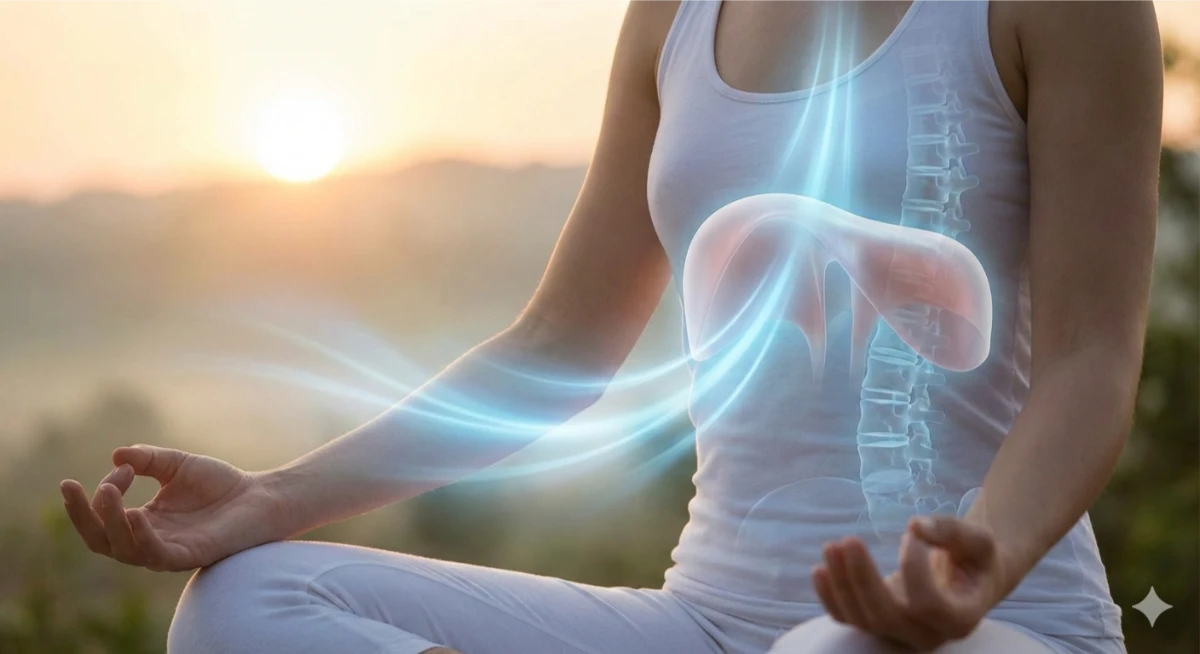

Take a breath right now and simply notice where it goes. Does the chest rise? Do the shoulders lift toward the ears? Most people have never once thought about this, yet how a person breathes reaches the back directly — shallow chest breathing creates constant tension through the neck, shoulders and spine, roughly twenty thousand times a day, since that is approximately how many breaths pass through an ordinary day without anyone noticing a single one of them. Research from the Journal of Physical Therapy Science found that diaphragmatic breathing reduced chronic low back pain by fifty-eight percent after just eight weeks — without the participants changing a single thing about their exercise routine. They simply changed how they breathed. This is the complete guide to exactly why that works and how to build it into daily life.
01Twenty Thousand Chances a Day
Every one of those twenty thousand daily breaths either supports the spine or quietly stresses it, and almost nobody has ever been taught to tell the difference between the two. The chapters ahead cover the actual mechanism connecting breath to spinal muscle, the specific techniques that produce real release, an honest look at breath retention and where it genuinely helps versus where it does not, how to coordinate breath with posture and movement, and the daily habit that turns all of this from a technique into something the back simply does without being asked.
02How Breath Reaches the Spine
The diaphragm, the primary muscle of breathing, attaches directly to the lumbar spine, which means every single breath taken genuinely affects that connection whether or not anyone notices it happening. When the diaphragm contracts on the inhale, it pulls gently on its lower-back attachments, and functioning properly, this creates a kind of built-in massage and stability with every cycle. Shallow breathing abandons this natural support system entirely — the spine loses its rhythmic stabilisation, and the back muscles end up working overtime, compensating for support that the breath itself should have been providing all along.
Chest breathing recruits accessory muscle — the scalenes, sternocleidomastoid and upper trapezius — none of which were built for constant breathing work. Asked to do that job twenty thousand times a day, they become chronically tight, and that tension radiates directly down into the upper and mid-back. Belly breathing, by contrast, uses the primary breathing muscle as intended, letting the accessory muscles finally rest and the tension genuinely dissolve. A simple test tells the two apart: one hand on the chest, one on the belly — whichever hand moves more during an ordinary breath reveals which pattern is currently running the show.
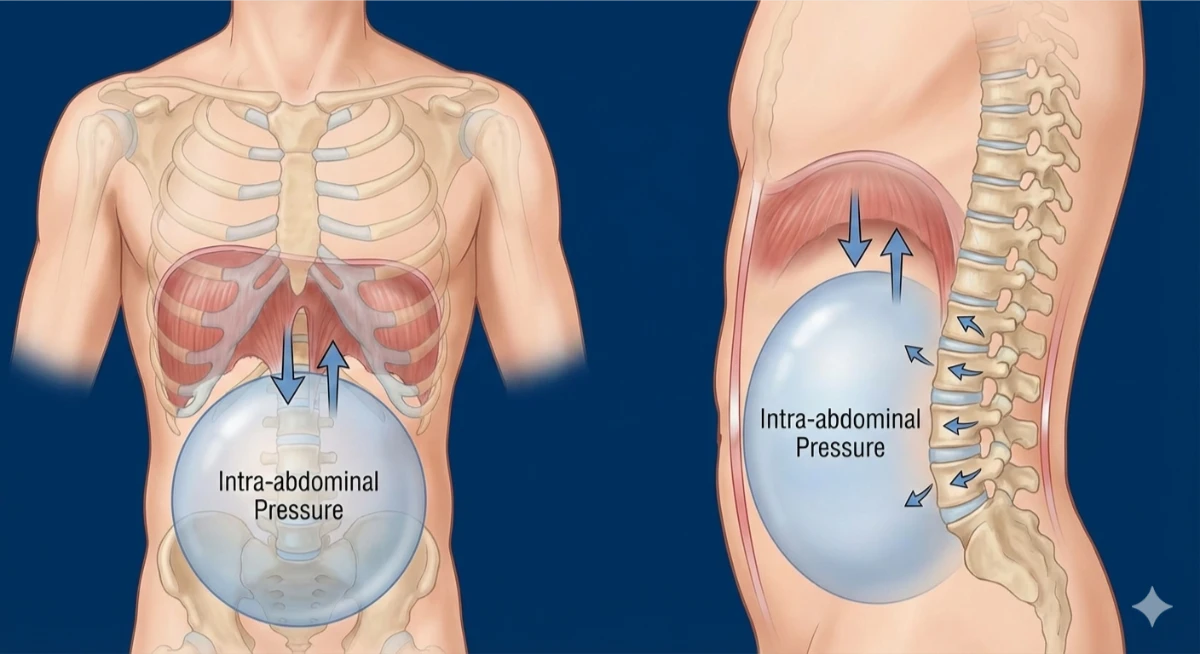
The torso itself functions as a pressure system. Proper breathing generates intra-abdominal pressure that supports the spine the way a natural weight belt would — the diaphragm forming the top of this cylinder, the pelvic floor forming the bottom, the core muscles forming the walls in between. When every part works together through proper breathing, the spine receives support from all sides at once, and that distribution measurably reduces strain on any single vertebra. Dr Stuart McGill, the spine biomechanics expert, put it directly: “Intra-abdominal pressure generation through breathing is fundamental to spine protection,” and his research found that proper breathing reduces spinal compression force by as much as forty percent.
Breath also reaches the spine through the nervous system directly. Shallow, rapid breathing activates the sympathetic stress response, which increases muscle tension throughout the body and especially through the back — the muscles, quite literally, guarding against a threat that in most cases is not actually there. Slow, deep breathing activates the parasympathetic response instead; muscle tension releases and pain perception genuinely decreases as a direct result. The Yoga Sutras (chapter 1, verse 34) put this ancient observation plainly: “Or by exhaling and retaining the breath, the mind becomes steady” — recognising breath’s power over the nervous system long before any biomechanics research existed to confirm it. For anyone already practising morning meditation, understanding this exact breath-spine connection deepens both practices considerably at once.
03Techniques for Real Release
Deep breathing is not only about moving more air; it is about creating a systematic release through the spine, and different techniques target a slightly different part of that same system.
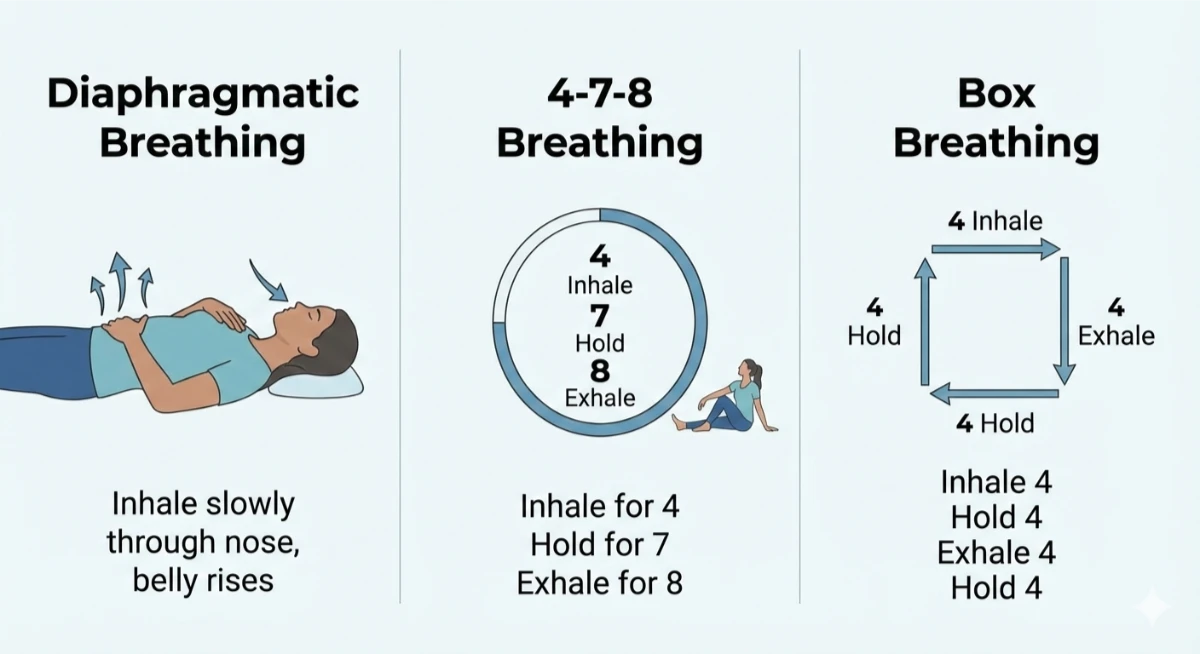
Diaphragmatic breathing. Lie on the back with the knees bent, one hand on the chest and one on the belly. Inhale slowly through the nose, directing the breath into the belly so the lower hand rises while the upper hand stays relatively still, then exhale slowly through the nose or mouth as the belly naturally falls. Five to ten minutes daily lets the nervous system gradually relearn this pattern on its own, without forcing the belly to expand — think of the torso as a balloon inflating evenly in every direction rather than in one place specifically.
4-7-8 breathing. Developed by Dr Andrew Weil and sometimes called the natural tranquilliser, this technique activates deep relaxation quickly: inhale through the nose for four counts, hold for seven, exhale completely through the mouth for eight, and repeat for four cycles. The extended exhale specifically is what activates the parasympathetic response and releases muscle tension along with it.
Box breathing. Used by Navy SEALs for stress management, this technique creates balanced nervous-system regulation through equal timing: inhale for four counts, hold for four, exhale for four, hold empty for four, repeated for five to ten rounds. The equal timing throughout creates a kind of equilibrium, and back muscle reliably releases its protective tension in response.
Extended exhale. Making the exhale longer than the inhale stimulates the vagus nerve directly, the body’s main relaxation pathway — inhale for four counts, exhale for six to eight, keeping the exhale smooth rather than forced. This particular ratio signals safety to the nervous system, and the back muscle responds by softening almost immediately.
Breathing into tension. Identify where the back actually feels tight and direct attention, not literally the breath itself, toward that exact area — inhale, imagine breath flowing into the tight spot; exhale, imagine the tension flowing back out with it. Awareness directs blood flow and nervous-system attention even though breath itself cannot physically travel there, and research in Pain Medicine found that directed breath awareness of this kind reduces pain intensity by roughly thirty-five percent. For anyone dealing specifically with lower back pain, these techniques provide genuine drug-free relief that complements a physical practice rather than replacing it.
Practise all of the above in a position that already supports the spine — lying with the knees bent works beautifully, as does a supported Child’s Pose with a bolster under the chest, or Legs-Up-the-Wall, which combines a gentle inversion with the breathing practice at the same time.
04Breath Retention: Separating Myth from Fact

Breath retention carries real mystique in yoga tradition, but for back pain relief specifically, the truth runs somewhat against the popular belief around it.
Classical pranayama includes kumbhaka, breath retention held after an inhale or an exhale, and advanced practitioners hold for genuinely extended periods as part of that tradition. These practices serve a real purpose within traditional yoga, but they are not actually ideal for managing back pain specifically. Holding the breath creates involuntary muscle tension throughout the body, especially through the core and back — a protective response that makes sense evolutionarily, but one that directly defeats the purpose when the actual goal is releasing exactly that kind of tension.
Retention, particularly after an inhale, also temporarily raises blood pressure. For most people a brief hold is not dangerous, but back pain often travels alongside stress-related issue more broadly, and adding a blood-pressure spike through retention practice is simply not the optimal choice in that context. A very short hold, two to three seconds at the top of an inhale, can help someone feel where the diaphragm actually sits, which is a useful refinement of technique rather than a retention practice in the traditional sense; a brief natural pause at the bottom of an exhale is similarly just a moment of rhythm rather than a forced hold.
For genuine spinal relaxation, continuous flowing breath outperforms a retention-based practice — a smooth transition between inhale and exhale maintains the relaxation response throughout, rather than interrupting it with a held pause. Think of the breath as a gentle wave: rhythmic, continuous, soothing, with no abrupt stop anywhere along it. The Hatha Yoga Pradipika (chapter 2, verses 71 to 72) describes advanced retention practice in real depth, but it also makes a point of recommending that a beginner focus first on smooth, comfortable breathing before attempting any of it. For anyone exploring yoga for slip disc and sciatica specifically, avoiding breath retention prevents adding extra spinal pressure during a period the body is already actively healing.
05Coordinating Breath With Posture
Breath and posture move together, and when properly synchronised, the two create a level of spinal support that neither produces alone.
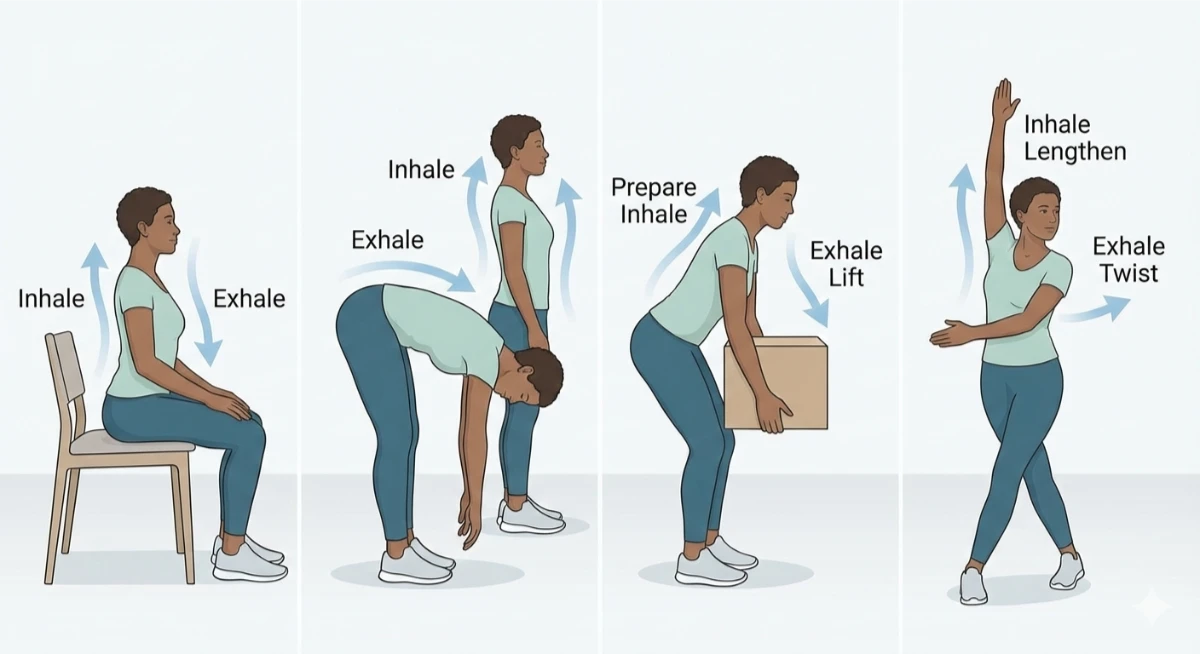
An inhale supports extension and expansion — the rib cage naturally lifts and opens, which is the moment to use for lengthening the spine. An exhale supports flexion and grounding — the core naturally engages, which is the moment to use for a forward bend or for deepening stability generally. None of this is arbitrary; it simply mirrors how the body already prefers to move on its own.
Sitting tall, an inhale lets the spine lengthen naturally as the head lifts slightly toward the ceiling; the following exhale should maintain that same length while softening unnecessary tension, never collapsing the posture just built, only releasing the effort that isn’t actually needed to hold it. Breath-synchronised sitting like this quietly turns an ordinary desk day from something that strains the back into something that actually supports it instead.
Lifting something calls for an inhale to prepare and an exhale on the lift itself — the exhale naturally engages the core and protects the spine through the motion. Bending forward calls for an inhale to lengthen the spine first and an exhale to hinge at the hips, keeping the back genuinely safe through the whole movement. Even walking becomes something closer to meditation when synchronised deliberately with breath — three or four steps on the inhale, three or four on the exhale.
Inside a yoga pose the same principle holds throughout: in Cat-Cow, inhale into Cow’s extension and exhale into Cat’s flexion, letting the breath guide the movement rather than the other way around; in a forward fold, inhale to lengthen and exhale to fold deeper, never folding on an inhale, which compresses the spine rather than releasing it; in a twist, inhale to lengthen upward and exhale to rotate, the exhale’s core engagement protecting the back through the rotation. For anyone following a morning yoga routine for back stiffness, this exact breath-movement coordination is what turns a simple stretch into something genuinely therapeutic rather than merely mechanical.
In a restorative pose, the same coordination softens rather than drives the movement — in supported bridge, breathe naturally while gravity does the actual work, letting each exhale sink a little deeper into the support beneath it; in supported Child’s Pose, the belly naturally presses against the thighs on the inhale, gently massaging the organs with every cycle; in Legs-Up-the-Wall, a subtle pelvic tilt can follow the breath directly — a slight arch on the inhale, a slight tuck on the exhale.
06Daily Habits for Lasting Back Health
Practising a technique occasionally has real value, but it is the daily habit built around breath that actually determines long-term back health over months and years rather than any single session.
A morning routine of five minutes of diaphragmatic breathing before even getting out of bed sets the nervous system’s tone for the entire day ahead — the body is naturally more relaxed first thing, which makes this the easiest possible moment to reinforce a healthy pattern before the day’s stress has a chance to override it. An hourly check — a simple reminder to notice shallow breathing or tense shoulders, followed by three to five deep diaphragmatic breaths — resets the pattern before tension has a chance to accumulate across the whole day; these small, frequent resets prevent exactly the kind of buildup that produces an ache by evening.
In a genuinely stressful moment — a difficult email, a traffic jam, a hard conversation — three slow, deep breaths before reacting keep that stress from translating directly into physical back tension; research from Harvard Medical School found that a brief breathing intervention during stress reduces measured muscle tension by fifty-two percent. An evening wind-down of ten minutes of extended-exhale breathing before bed transitions the nervous system from the day’s activity toward genuine rest, releasing accumulated tension and setting up a more restorative sleep — and better sleep, in turn, means better overnight back recovery. Pairing this with gentle stretches for lower back pain rounds out a genuinely comprehensive evening routine.
Working seated, coordinate breath with a posture check every twenty to thirty minutes — a deep breath in to lengthen the spine, a breath out to reset the shoulders. Working standing, three energising breaths each hour, focused on a full inhale, help maintain energy through a long shift. Doing physical labour, breathe consciously through every lift, exhaling specifically during the exertion itself rather than holding through it.
Combine this breathwork with physiotherapy exercises for lower back pain, coordinating breath with each repetition for a genuinely enhanced therapeutic effect. Add it to a long hold within a yin yoga class, where the breath deepens the practice’s effectiveness considerably. And bring it in before an ashtanga open practice too, preparing the body properly before more vigorous movement begins.
Start with just one of these daily practices — morning breathwork, or the hourly check, or the evening wind-down — and once it holds steady for two to three weeks, add a second rather than attempting all four at once. A tiny, consistent practice reliably outperforms an ambitious, sporadic one, every single time it has actually been tested.
Start tonight with five minutes of diaphragmatic breathing before bed — the back genuinely tends to feel noticeably lighter by morning.
“Twenty thousand breaths a day. Each one either supports the spine, or quietly stresses it — almost nobody has ever been taught to tell the two apart.”
The heart of it
- The diaphragm attaches directly to the lumbar spine — how you breathe is not separate from how your back feels.
- 4-7-8, box breathing and an extended exhale each activate the parasympathetic response through a slightly different route.
- Continuous flowing breath supports spinal relaxation better than breath retention, which is better suited to other goals entirely.
- Coordinating breath with posture and movement turns an ordinary stretch or lift into something genuinely protective for the spine.
Go deeper with Adhiroha’s Pranayama and Meditation TTC.
Reserve Your Seat