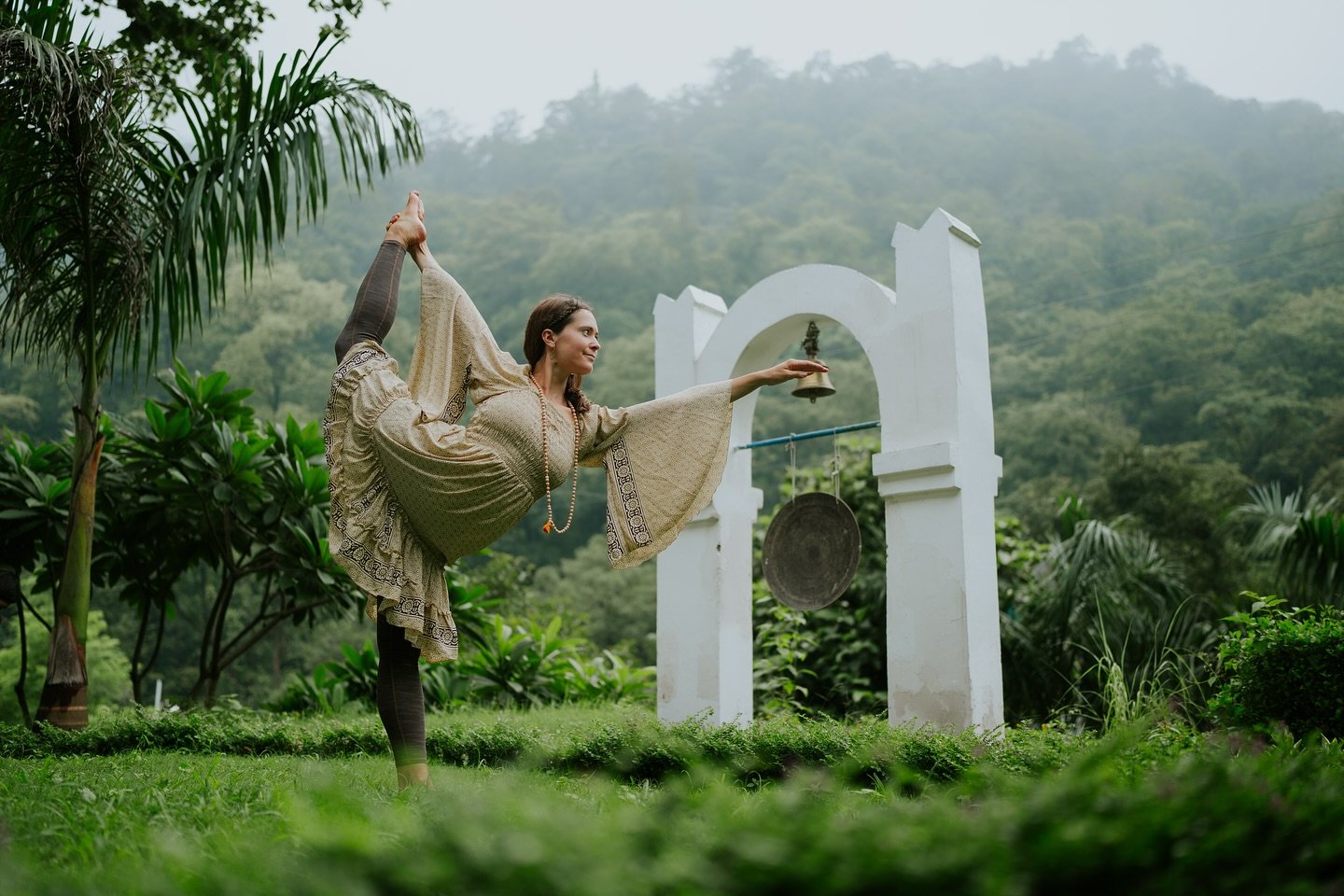

Some places you visit. Rishikesh you arrive at — usually a little tired, a little unsure — and somewhere between the morning bells and the evening lamps on the Ganga, something in you quietly settles. Long after the flight home, most people find that the town has not really let them go. This is the story of why seekers have walked toward this small Himalayan town for thousands of years, and what it might hold for you.
01Why the World Calls It the Yoga Capital
Rishikesh sits exactly where the Ganga leaves the Himalayas and spills onto the plains — a threshold place, cool and green, ringed by forested hills. The old texts already knew this spot: sages are said to have performed penance here long before anyone called it a destination, and the name itself — ‘Hrishikesh’, Lord of the Senses — speaks of mastery over the restless mind rather than mastery over a posture.
Long before it appeared on any traveller’s list, sages came here to sit, to breathe, and to listen. That lineage never really left. Today the town holds hundreds of schools, ashrams and riverside shalas, but the reason it earned the name ‘the yoga capital of the world’ is simpler than the numbers suggest. Here, yoga was never a class you attend for an hour. It is the rhythm of a whole day — and the town is still built around that rhythm.
Even the geography seems to agree. The Himalayas rise close enough to cool the air and slow the pace, while the river keeps everything moving — a daily reminder that stillness and flow are not opposites, but partners.
“You do not come to Rishikesh to add yoga to your life. You come to remember a way of living the practice was always pointing toward.”
02A Morning by the Ganga
The day begins before the sun. The air is cool and almost silent, save for birdsong and the far-off bell of a temple. By the time most of the world is waking, you have already moved through your first practice, watched the light spread across the water, and eaten a warm, simple breakfast.
Mornings feel longer here, in the best possible way. There is time — for the breath, for a slow walk to the ghats, for a cup of chai without a screen in your hand. Between asana and the first meal there is usually a pranayama and meditation sitting, unhurried, followed by a short talk on philosophy that slowly turns abstract ideas into something you can actually feel. It is this unhurried quality, more than any single posture, that people carry home.
If you only do one thing in Rishikesh, do this: sit by the river at first light, before the town wakes, and simply breathe. Everything the practice teaches is already there.
03A Living Tradition, Not a Museum
It would be easy for a place this famous to become a performance. Rishikesh mostly resists that. The teachers here did not learn yoga from a weekend course — many were raised inside the tradition, guided by their own gurus for ten or twenty years before they ever taught.
What you receive, then, is not a trend but a transmission: Hatha and Ashtanga Vinyasa held with real precision, the science of the breath, the philosophy of Patanjali, the quiet discipline of meditation. It is offered plainly, without ego, the way it has been passed hand to hand for generations.
This lineage also shows up in small, unglamorous ways — a teacher correcting your alignment with one quiet touch, a chant that has been sung the same way for centuries, an evening spent simply listening rather than performing. None of it photographs particularly well. All of it is the actual point.
04Who Walks Toward This Town
Seekers arrive from over seventy countries, and almost none of them are what you might expect. They are not all bendy or young or certain. They are:
- People who dream of teaching one day — and want to begin properly
- Practitioners who simply wish to go deeper than a studio class allows
- Those quietly worn out by city life, looking for a reset by the river
- First-timers who felt an inexplicable pull and decided, finally, to follow it
- People rebuilding themselves after illness, loss, or a season that asked too much of them
Whatever the reason, the town has a way of meeting each person exactly where they are. You need not be flexible, experienced, or sure. You need only be willing to show up.
05Where the Beatles Once Sat
Part of Rishikesh’s modern story was written in the winter of 1968, when the Beatles arrived at Maharishi Mahesh Yogi’s ashram — now known simply as ‘the Beatles Ashram’, tucked inside the forest across the river. In a few quiet weeks of meditation there, the band wrote much of what became the White Album.
The ashram sat abandoned for decades, slowly reclaimed by the trees, before it reopened as a heritage site where visitors now wander among moss-covered meditation domes, faded murals and old stone huts. It is a strange, moving reminder that the town’s pull on the searching mind is not a recent trend — it has been drawing people inward for a very long time.
06Sacred Geography: Ghats, Temples and Two Swaying Bridges
Two suspension bridges, Ram Jhula and Lakshman Jhula, string the town together across the Ganga, humming with the footsteps of pilgrims, cows, motorbikes and the occasional monkey. Below them, ghats such as Triveni and Parmarth Niketan fill each evening with the flicker of oil lamps.
Further out, the road climbs toward Neelkanth Mahadev, a Shiva temple hidden in the forested hills where, legend says, Shiva swallowed the poison churned from the cosmic ocean to save the world. None of this is required reading for a yoga student — but wandering through it, you start to understand why the practice took root here and nowhere else quite like it.
07Beyond the Mat
The practice does not end when you roll up your mat. It follows you into the sattvic meals eaten in shared silence, the evening Ganga aarti with its thousand floating lamps, the treks to hidden waterfalls, and the long conversations with people who arrived as strangers and leave as family.
Even the food teaches something: simple vegetarian thalis, cooked without excess, meant to keep the body light and the mind clear rather than to impress. Meals here are rarely eaten in a hurry, and that, too, is part of the curriculum.
“People come for the certificate, and leave talking about the place — the brook, the birdsong, and the strange ease of days that finally make sense.”
08A Kind of Coming Home
Ask anyone who has spent real time here and they will struggle to explain it. The postures improve, yes. The breath deepens. But the change most people describe is quieter: they see their own life a little more clearly than when they arrived.
That is the real journey of transformation Rishikesh offers. Not to make you into someone new — but to help you find your way back to the person you quietly already were. Most students say the same thing on their last morning by the river: it was never really about the yoga. It was about remembering how to live.
The heart of it
- Rishikesh earned its name by keeping yoga a way of life, not a class.
- The town’s unhurried rhythm — and its living lineage of teachers — is its deepest teaching.
- Its sacred geography, from the Beatles Ashram to Neelkanth temple, has drawn seekers inward for generations.
- You do not need experience or flexibility — only willingness.
If the pull toward this town feels familiar, perhaps it is time to answer it. Come and experience the practice where it has always lived.
Reserve Your Seat